Ventricular rhythms
Sinus Tachycardia With PVCs on an EKG Strip
Sinus tachycardia with PVCs is a fast sinus rhythm interrupted by premature ventricular contractions. The beats that belong to the sinus rhythm come faster than 100 a minute, each one led by an upright P wave and followed by a narrow QRS. Now and then a different beat cuts in ahead of time: wide, with no P wave, and with a T wave that points away from its QRS. The strip is named for both things it shows.
Criteria from the American Heart Association guidelines and published ECG standards · Every strip checked by measurement · Sources and method · Updated November 15, 2026
- Rate
- Sinus beats > 100
- PR interval
- 0.12–0.20 s on the sinus beats
- QRS
- Narrow, with wide PVCs
How to identify sinus tachycardia with PVCs in five steps
Ask the same five questions of every strip. The right-hand column is what each one finds on the strip above.
1Rate
Measure between two sinus beats that stand next to each other: fewer than 15 small squares apart means faster than 100. A six-second count, with the PVCs included, gives nearly the same answer.
Sinus beats 111 bpm
2Rhythm
Regular and quick, broken where a PVC arrives early and a gap follows it.
Regular, with early beats
3P waves
Upright and alike before every sinus QRS, sitting close behind the T wave of the beat before. The PVCs have none.
None on the early beat
4PR interval
Normal on the sinus beats, usually toward the short end because the rate is high. A PVC has no PR interval.
0.13 s on sinus beats
5QRS
Under 0.12 seconds on every sinus beat. Each PVC measures 0.12 seconds or more.
0.08 s; early beat 0.16 s
What is happening in the heart
The sinus node is still in charge, and it is being driven hard, most often by adrenaline: pain, fever, blood loss, fear or a failing heart all speed it up. The same conditions make ventricular muscle irritable. A spot in a ventricle reaches its firing point before the next sinus impulse arrives and sets off a beat of its own. That impulse travels from cell to cell without using the fast conduction fibres, so the QRS it draws is wide. The sinus node is not reset by it, which is why the following sinus beat lands where it would have landed anyway and a gap appears after the early beat.
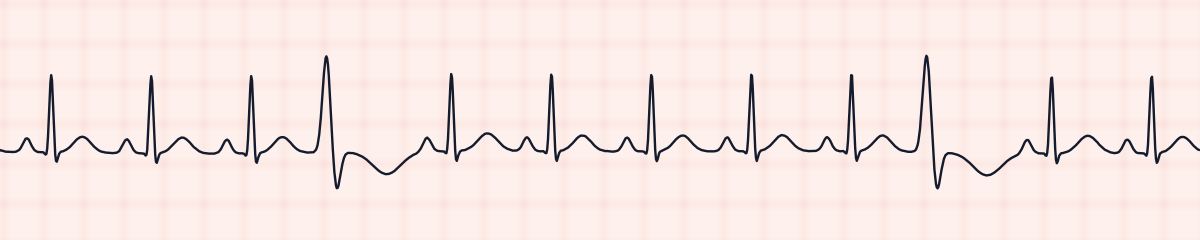
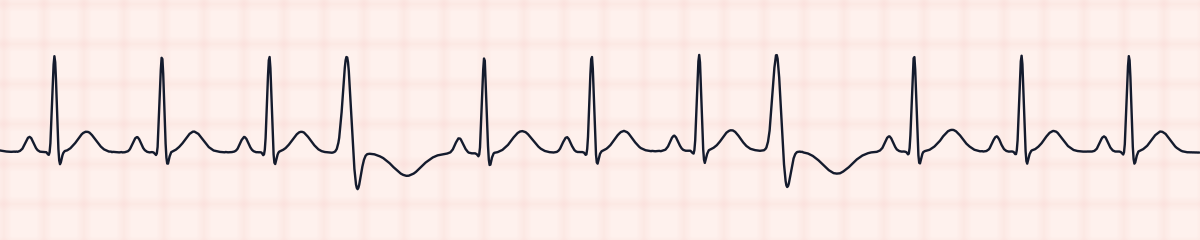
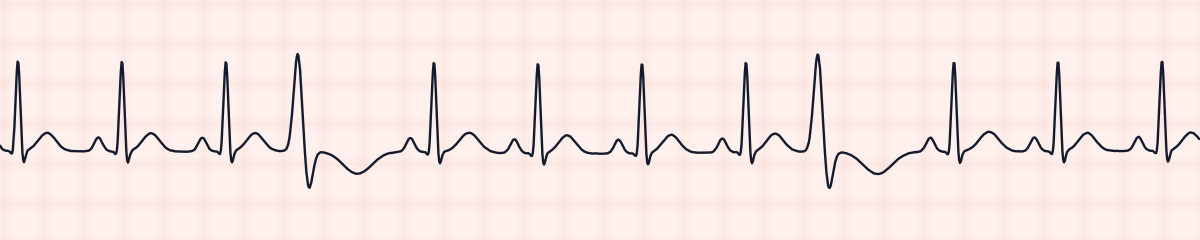
More sinus tachycardia with PVCs strips: no two are the same
A rhythm is a set of rules, not a picture. These three strips all meet the rules for sinus tachycardia with PVCs, with different numbers.
What sinus tachycardia with PVCs get mistaken for
Sinus tachycardia with PVCs vs. premature ventricular contractions (PVCs)
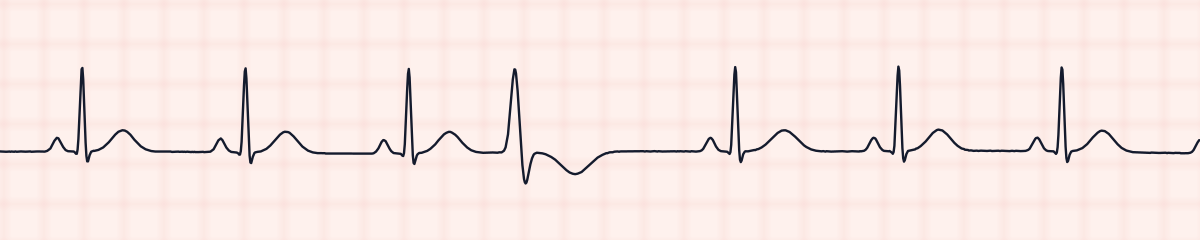
Sinus rhythm with PVCs is the same picture at a sinus rate of 100 or less. The early beats look identical; only the spacing of the sinus beats separates the two names, so that spacing has to be measured.
Sinus tachycardia with PVCs vs. sinus tachycardia
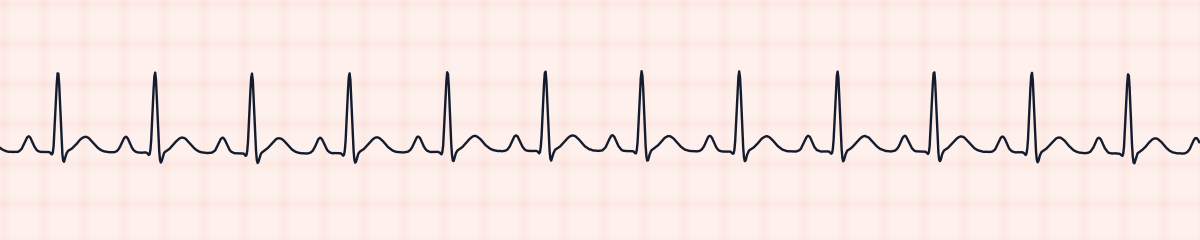
Plain sinus tachycardia never breaks step. Every QRS is narrow and every one has its P wave, from the first beat on the paper to the last.
Sinus tachycardia with PVCs vs. premature atrial contractions (PACs)
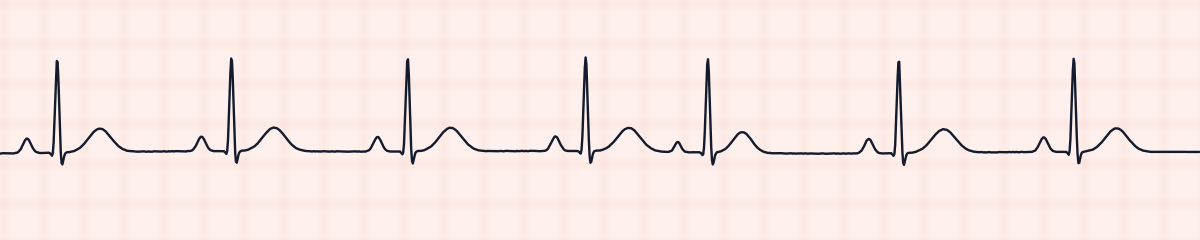
A premature atrial beat is early as well, but it is narrow and carries a P wave of its own, often perched on the T wave ahead of it. A ventricular beat is wide, and nothing atrial leads it.
Sinus tachycardia with PVCs vs. ventricular tachycardia
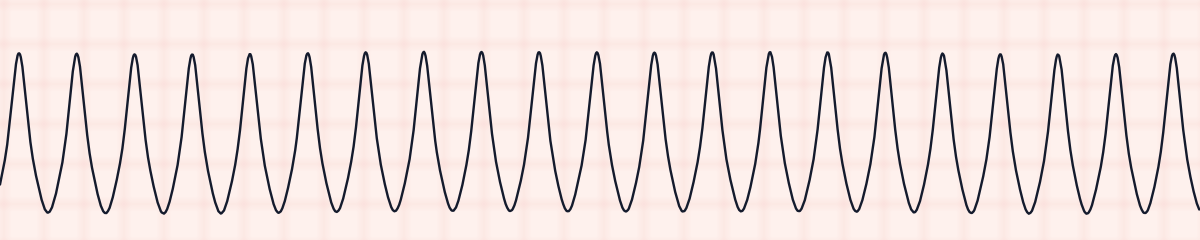
One wide beat among fast narrow ones is a PVC. Ventricular tachycardia needs three or more wide beats in succession, and while it lasts no sinus beat gets through.
Sinus tachycardia with PVCs vs. ventricular bigeminy
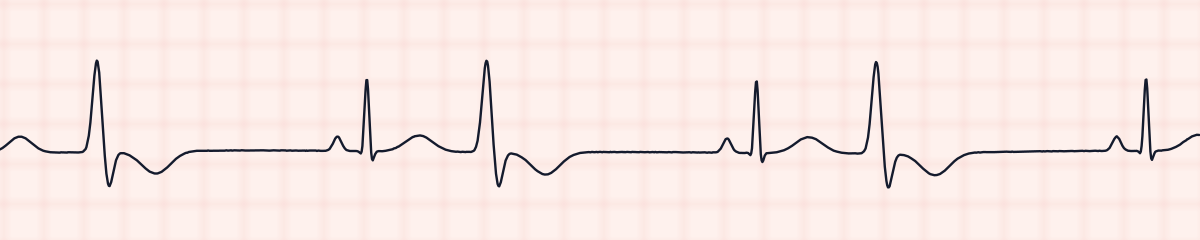
In bigeminy a PVC follows each sinus beat, so narrow and wide alternate along the whole strip. Here several sinus beats pass between one PVC and the next.
Practice: sinus tachycardia with PVCs or a look-alike?
Five strips. Some show sinus tachycardia with PVCs; the others are the rhythms most often confused with it.
Strip 1 of 5
Lead II · 25 mm/s · 6 s
Causes of sinus tachycardia with PVCs
- Pain, anxiety or fever, which raise the sinus rate and can provoke ectopic beats
- Bleeding or dehydration: a low circulating volume
- Low oxygen from any cause, including a pulmonary embolism
- A heart attack or ongoing myocardial ischemia
- Heart failure
- Low potassium or low magnesium
- Stimulants: caffeine, nicotine, cocaine, decongestants, and inhaled or infused adrenaline-like drugs
- An overactive thyroid
- Sepsis
Why it matters
Neither finding is a diagnosis; both are signs that something is pushing the heart. A fast rate shortens the time the ventricles have to fill and raises the oxygen the heart muscle needs, and PVCs appearing on top of it suggest the muscle is already irritable. In a patient with chest pain, a low potassium level or falling oxygen saturation, that pairing deserves prompt attention. PVCs that grow more frequent, change shape, or begin to arrive in pairs and short runs are the changes that get reported.
What is done for sinus tachycardia with PVCs
- Assess the patient first: blood pressure, oxygen saturation, pain, temperature, bleeding, level of anxiety.
- Look for what is driving the rate; the tachycardia usually settles when its cause is treated, not when the rate itself is targeted.
- Count the PVCs over a minute and note whether they all look alike.
- Expect potassium and magnesium to be checked and replaced if they are low.
- Report PVCs that are new or increasing, any couplet, and any run of three or more.
- Keep the patient on the monitor and save a strip that shows both findings.
Study summary, not a protocol. Follow current American Heart Association guidelines and your facility’s policies. See the medical disclaimer.
Common mistakes with sinus tachycardia with PVCs
- Writing down “sinus tachycardia” and leaving out the PVCs, or the other way round.
- Deciding the rate by eye. At 95 and at 110 the strip looks much the same until the squares between two sinus beats are counted.
- Taking the fast rate plus a wide beat for ventricular tachycardia. Check how many wide beats come in a row.
- Seeing the gap that follows a PVC and reporting a heart block. No P wave stands alone in that gap.
- Treating the PVCs as the problem when the patient is tachycardic from pain, fever or blood loss.
Questions about sinus tachycardia with PVCs
How do you name a strip that has sinus tachycardia and PVCs?
Underlying rhythm first, then what interrupts it: sinus tachycardia with PVCs. Add the sinus rate and how often the PVCs come, for example “sinus tachycardia at 118 with occasional uniform PVCs”.
How do you work out the heart rate when there are PVCs?
Use two sinus beats that are side by side and count the small squares between their R waves; 1500 divided by that number is the sinus rate. For the overall ventricular rate, count every QRS in six seconds, PVCs included, and multiply by ten.
Are PVCs with a fast heart rate dangerous?
It depends on why they are there. In a healthy person after coffee or exercise they are usually harmless. In a patient with a heart attack, heart failure, low potassium or low oxygen, frequent PVCs at a fast rate can come before more serious ventricular rhythms and are reported.
Why do PVCs show up when the heart is beating fast?
Much of what speeds the sinus node also irritates the ventricles: adrenaline, low oxygen, ischemia, stimulant drugs and electrolyte loss. The two findings often share one cause.