Junctional rhythms
Junctional rhythm EKG strip
A junctional rhythm, or junctional escape rhythm, starts in the AV junction instead of the SA node. On an EKG strip it is regular, at 40 to 60 beats per minute, with a narrow QRS. The P wave is absent, or it is inverted in lead II and appears just before, inside or just after the QRS.
Criteria from the American Heart Association guidelines and published ECG standards · Every strip checked by measurement · Sources and method · Updated November 15, 2026
- Rate
- 40–60
- PR interval
- None, or under 0.12 s
- QRS
- < 0.12 s
How to identify a junctional rhythm in five steps
Ask the same five questions of every strip. The right-hand column is what each one finds on the strip above.
1Rate
40 to 60. The same rhythm at 60 to 100 is accelerated junctional rhythm, and above 100 it is junctional tachycardia.
52 bpm
2Rhythm
Regular.
Regular
3P waves
Often not visible. If seen, it is inverted in lead II and sits immediately before or after the QRS.
None visible
4PR interval
None, or shorter than 0.12 s when an inverted P wave comes first.
None
5QRS
Narrower than 0.12 s.
0.08 s
What is happening in the heart
The tissue around the AV node can act as a pacemaker at 40 to 60 beats per minute. It normally never gets the chance, because the faster SA node resets it with every beat. If the SA node slows below that rate, or its impulses stop arriving, the junction takes over. From there the impulse travels down the normal pathway, giving a narrow QRS, and backward up into the atria, which is why any P wave points downward.
More junctional rhythm strips: no two are the same
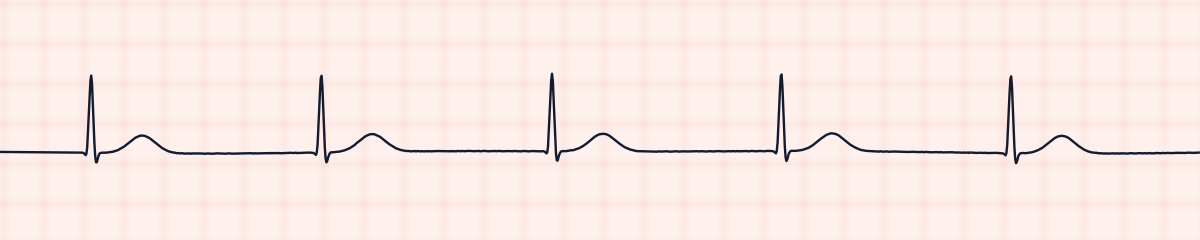
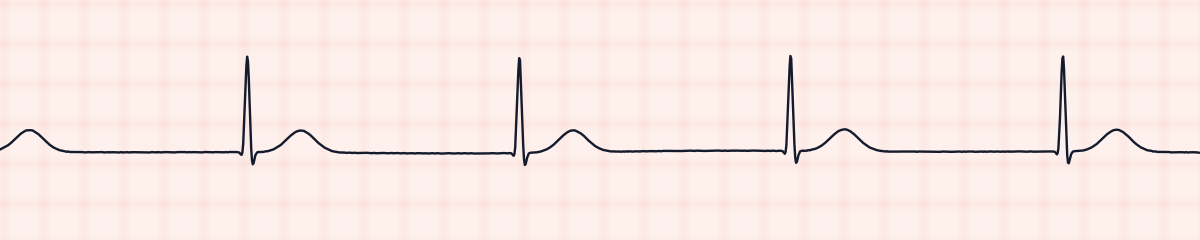
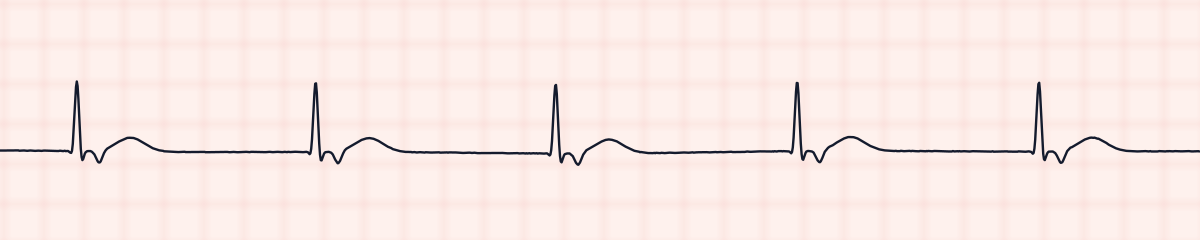
A rhythm is a set of rules, not a picture. These three strips all meet the rules for a junctional rhythm, with different numbers.
What a junctional rhythm gets mistaken for
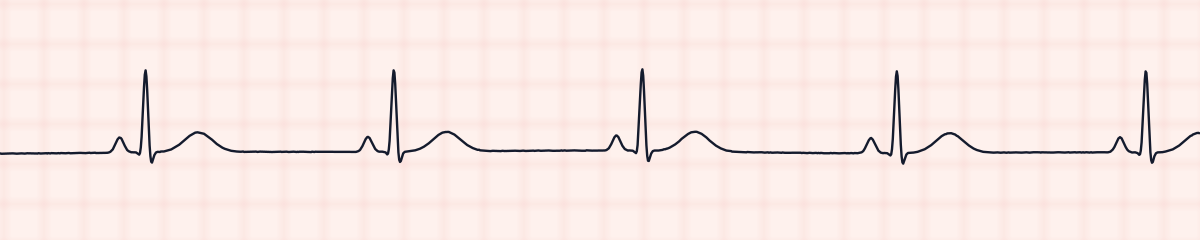
Junctional rhythm vs. sinus bradycardia
Sinus bradycardia covers the same range of rates with the same narrow QRS. It has a normal upright P wave before every beat at a PR of 0.12 s or more. A junctional rhythm does not.
Junctional rhythm vs. idioventricular rhythm
Both are slow escape rhythms without P waves. Measure the QRS: narrow means the junction is the pacemaker, and wide with a rate under 40 means the ventricles are.
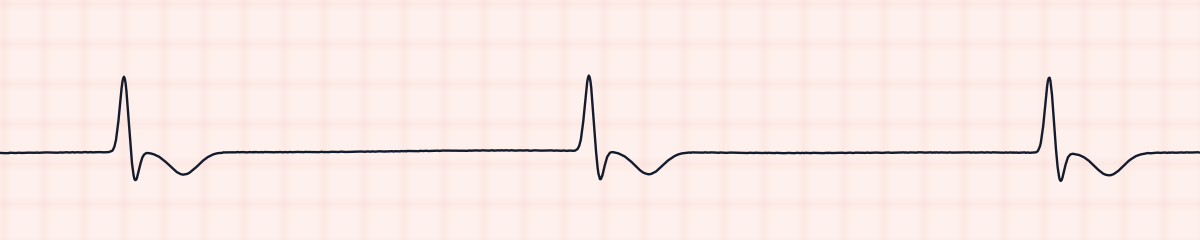
Junctional rhythm vs. accelerated junctional rhythm
The same rhythm, faster. A rate between 60 and 100 is accelerated junctional rhythm.
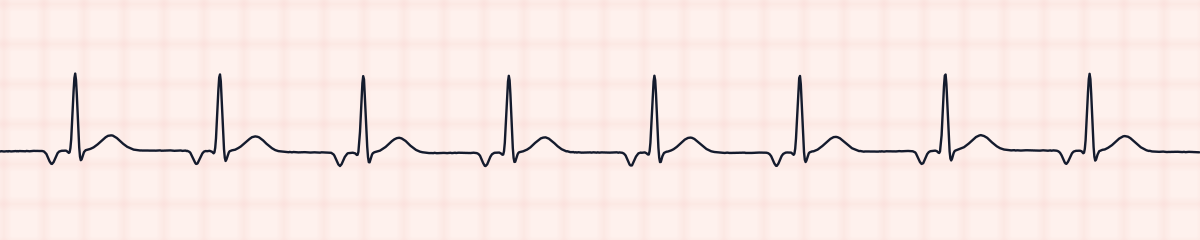
Practice: a junctional rhythm or a look-alike?
Five strips. Some show a junctional rhythm; the others are the rhythms most often confused with it.
Strip 1 of 5
Lead II · 25 mm/s · 6 s
Causes of a junctional rhythm
- An SA node that has slowed or failed, as in sick sinus syndrome
- Digoxin toxicity
- Beta blockers and calcium channel blockers
- Inferior myocardial infarction
- High vagal tone
- The period after cardiac surgery
Why it matters
A junctional escape rhythm is a safety net: it is what keeps the heart beating when the SA node does not. It is often tolerated well. Two things are lost, though: the rate is slow, and the atria no longer contract just before the ventricles, so the ventricles fill less completely. Together those can lower blood pressure.
What is done for a junctional rhythm
- Assess how the patient is tolerating the rate.
- Look for the reason the sinus node is not in control: medications, a digoxin level, a recent heart attack.
- Do not try to suppress the rhythm; it is the backup.
- If the slow rate causes symptoms, it is treated as bradycardia with atropine and, if needed, pacing.
- Hold drugs that slow the heart, as ordered.
Study summary, not a protocol. Follow current American Heart Association guidelines and your facility’s policies. See the medical disclaimer.
Common mistakes with a junctional rhythm
- Assuming a slow narrow rhythm is sinus bradycardia without confirming the P waves.
- Reading a small inverted P wave after the QRS as part of the ST segment.
- Missing complete heart block: if upright P waves march through unrelated to the QRS, the junctional rhythm is an escape below a block.
Questions about a junctional rhythm
What is the rate of a junctional rhythm?
40 to 60 beats per minute, the natural rate of pacemaker cells in the AV junction. At 60 to 100 it is called accelerated junctional rhythm, and above 100 junctional tachycardia.
Does a junctional rhythm have P waves?
Not normal ones. The atria are activated backward from the junction, so a P wave, if visible, is inverted in lead II. It may come just before the QRS with a short PR interval, be hidden inside the QRS, or follow it.
Is a junctional rhythm dangerous?
It is often well tolerated, and it protects the patient when the sinus node fails. It is investigated because something has stopped the sinus node from leading, and treated if the slow rate causes symptoms.
Why is the QRS narrow in a junctional rhythm?
Because the impulse starts above the ventricles and reaches them through the normal conduction system, both ventricles are activated quickly and together, just as in a sinus beat.