Ventricular rhythms
Torsades de pointes EKG strip
Torsades de pointes is a form of polymorphic ventricular tachycardia that occurs with a long QT interval. On an EKG strip it is a fast wide rhythm, usually 200 to 250 per minute, whose complexes grow taller, then smaller, then flip to point the other way, so the trace looks as if it is twisting around the baseline.
Criteria from the American Heart Association guidelines and published ECG standards · Every strip checked by measurement · Sources and method · Updated November 15, 2026
- Rate
- 200–250
- PR interval
- None
- QRS
- Wide, changing shape
How to identify torsades de pointes in five steps
Ask the same five questions of every strip. The right-hand column is what each one finds on the strip above.
1Rate
About 200 to 250 per minute.
~221/min
2Rhythm
Fast and roughly regular in its timing, but the height changes continuously.
Fast, twisting
3P waves
None visible.
None
4PR interval
None.
None
5QRS
Wide, with no fixed shape. The amplitude rises and falls in spindles and the direction reverses.
Wide, changing
What is happening in the heart
When the QT interval is prolonged, the ventricles take too long to recharge after each beat, and different regions recharge at different times. An early beat that lands in that vulnerable period can start a circuit that keeps shifting its path through the ventricles. Because the path keeps changing, the shape and direction of the QRS keep changing, which produces the spindle pattern. The name is French for “twisting of the points.”
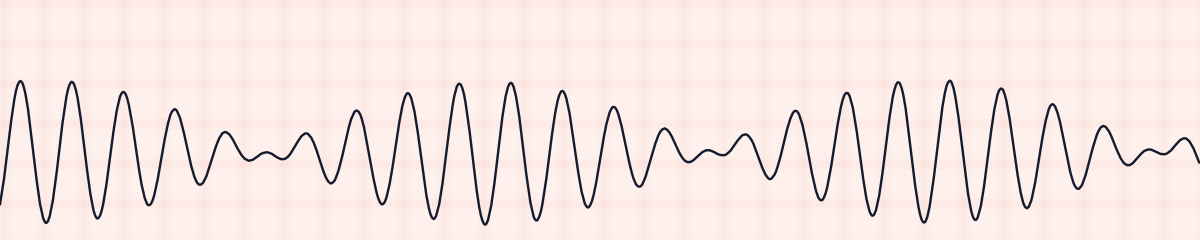
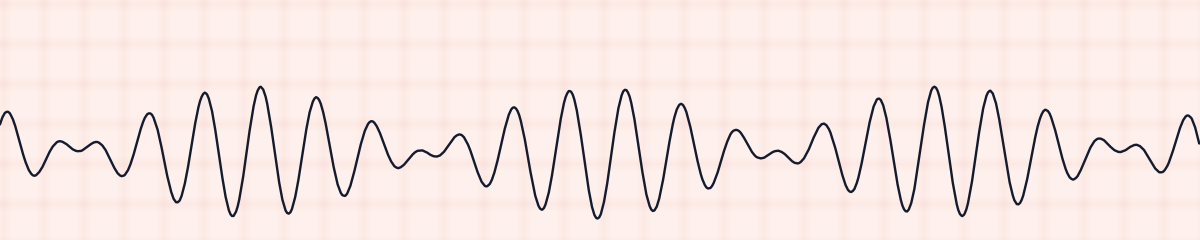
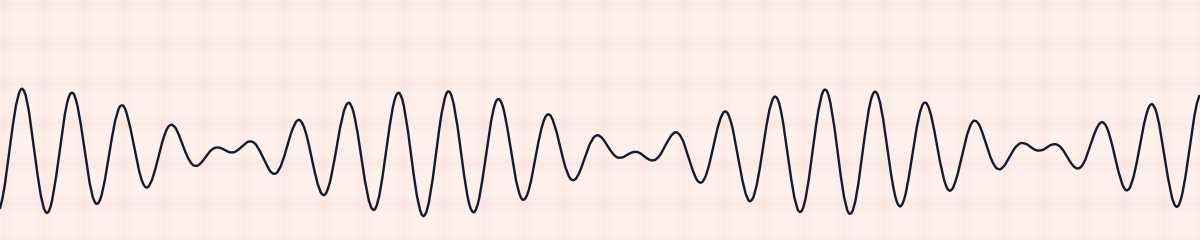
More torsades de pointes strips: no two are the same
A rhythm is a set of rules, not a picture. These three strips all meet the rules for torsades de pointes, with different numbers.
What torsades de pointes gets mistaken for
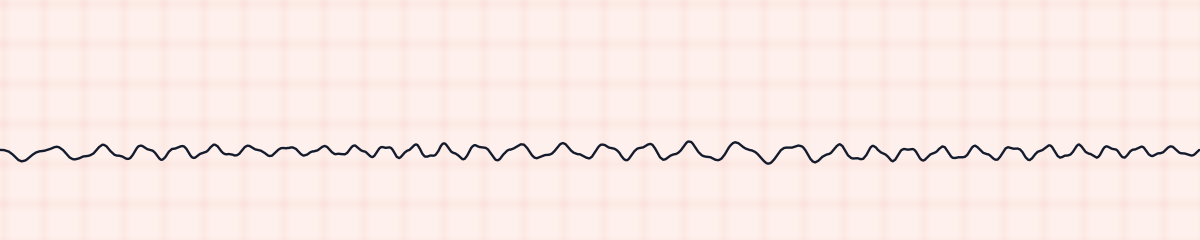
Torsades de pointes vs. ventricular fibrillation
Ventricular fibrillation is chaotic throughout, with no repeating beat. Torsades keeps a steady beat while its height swells and narrows in a pattern you can follow.
Torsades de pointes vs. ventricular tachycardia
In monomorphic ventricular tachycardia every complex has the same shape and height. In torsades the height and direction change from one second to the next.
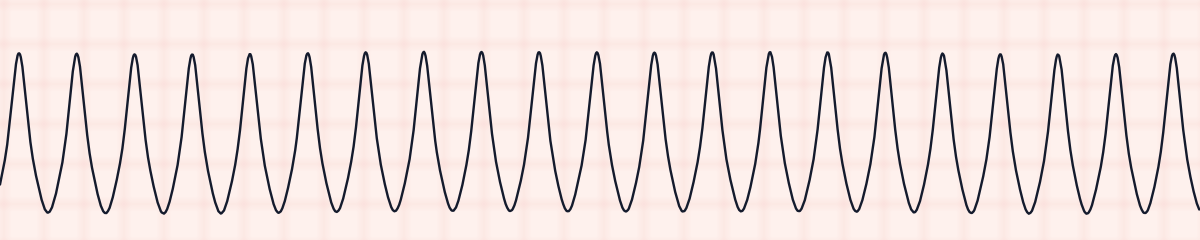
Practice: torsades de pointes or a look-alike?
Five strips. Some show torsades de pointes; the others are the rhythms most often confused with it.
Strip 1 of 5
Lead II · 25 mm/s · 6 s
Causes of torsades de pointes
- Drugs that prolong the QT interval: some antiarrhythmics, antipsychotics, antibiotics, antiemetics and methadone
- Low magnesium
- Low potassium
- Low calcium
- Congenital long QT syndrome
- A very slow heart rate or a long pause
Why it matters
Torsades often comes in bursts that stop spontaneously, with the patient fainting or feeling faint. But a burst can also continue and degenerate into ventricular fibrillation. It is singled out from other ventricular tachycardias because its treatment is different and because some of the usual antiarrhythmic drugs lengthen the QT further and make it worse.
What is done for torsades de pointes
- Check for a pulse and responsiveness.
- No pulse, or unstable: defibrillate. The changing complexes cannot be synchronized reliably.
- Give IV magnesium sulfate, the specific treatment, even when the magnesium level is normal.
- Stop every drug that prolongs the QT interval.
- Correct potassium.
- For recurrent torsades triggered by slow rates, the heart rate may be increased by pacing.
- Measure the QT interval once a sinus rhythm returns, and report it.
Study summary, not a protocol. Follow current American Heart Association guidelines and your facility’s policies. See the medical disclaimer.
Common mistakes with torsades de pointes
- Treating it like ordinary V-tach with a QT-prolonging antiarrhythmic.
- Calling it V-fib and missing the cause, so that the QT-prolonging drug is continued.
- Dismissing a short self-ending burst. It predicts another one.
Questions about torsades de pointes
What does torsades de pointes look like on an EKG?
A fast, wide-complex rhythm in which the QRS complexes gradually get larger and smaller and change direction, giving a spindle or ribbon-twisting appearance around the baseline.
What is the treatment for torsades de pointes?
IV magnesium sulfate is the specific treatment, together with stopping QT-prolonging drugs and correcting potassium. A pulseless or unstable patient is defibrillated.
What causes torsades de pointes?
A prolonged QT interval. The commonest causes are medications that lengthen the QT, low magnesium, low potassium, and inherited long QT syndrome.
Is torsades the same as V-fib?
No. Torsades is a polymorphic ventricular tachycardia with an organized, if changing, pattern, and it may stop on its own. It can, however, turn into ventricular fibrillation, which never stops without a shock.