Junctional rhythms
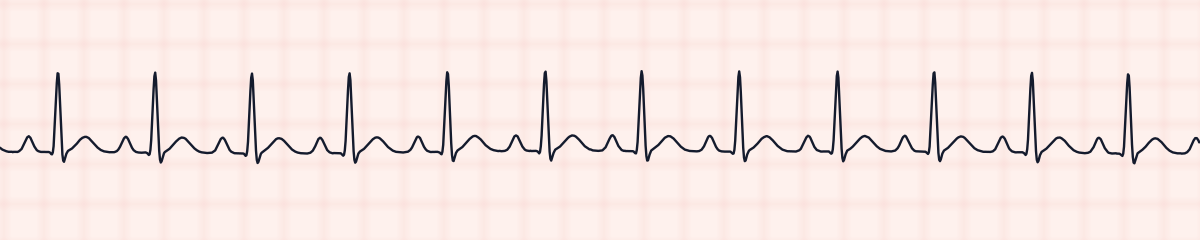
Junctional tachycardia EKG strip
Junctional tachycardia is a fast rhythm, above 100 per minute, that starts in the AV junction. The strip shows evenly spaced narrow QRS complexes and no normal P wave ahead of them: the P wave is hidden, or it is upside down in lead II and sits right beside the complex.
Criteria from the American Heart Association guidelines and published ECG standards · Every strip checked by measurement · Sources and method · Updated November 15, 2026
- Rate
- > 100
- PR interval
- None, or under 0.12 s
- QRS
- < 0.12 s
How to identify junctional tachycardia in five steps
Ask the same five questions of every strip. The right-hand column is what each one finds on the strip above.
1Rate
Over 100, most often 100 to 180.
121 bpm
2Rhythm
Regular.
Regular
3P waves
Not visible, or inverted in lead II next to the QRS.
Inverted, before each QRS
4PR interval
None, or under 0.12 s when an inverted P wave leads.
0.11 s, short
5QRS
Under 0.12 s.
0.08 s
What is happening in the heart
Pacemaker cells in the AV junction, which normally idle at 40 to 60, have become overactive and are firing faster than 100. They outpace the SA node and drive the ventricles through the normal conduction system, which keeps the QRS narrow. Because the cause is overactive tissue and not a short circuit, the rate tends to warm up and cool down gradually instead of switching on and off.
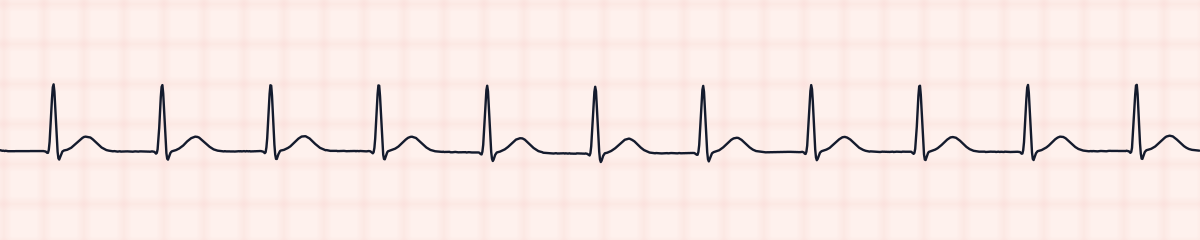
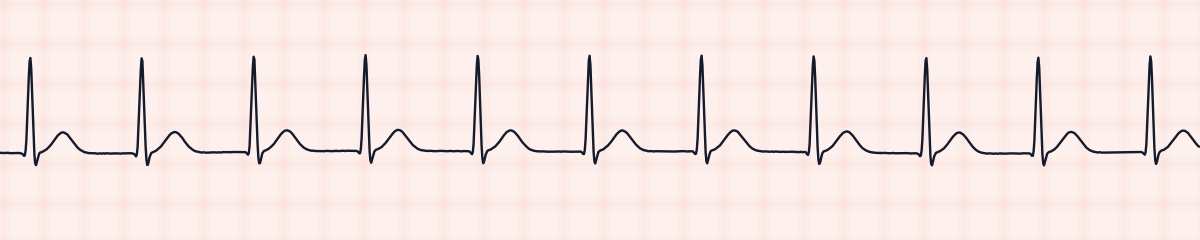
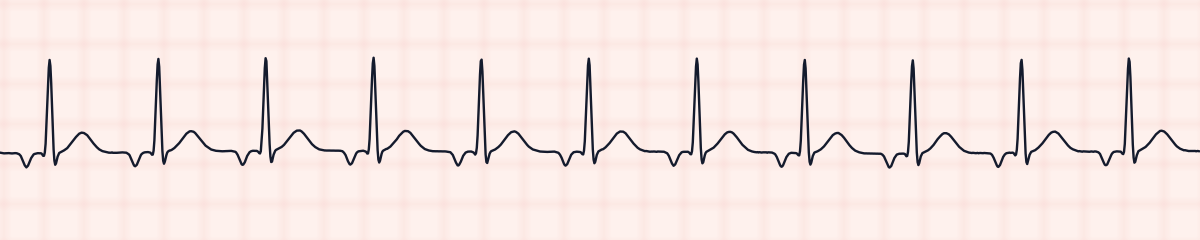
More junctional tachycardia strips: no two are the same
A rhythm is a set of rules, not a picture. These three strips all meet the rules for junctional tachycardia, with different numbers.
What junctional tachycardia gets mistaken for
Junctional tachycardia vs. supraventricular tachycardia (SVT)
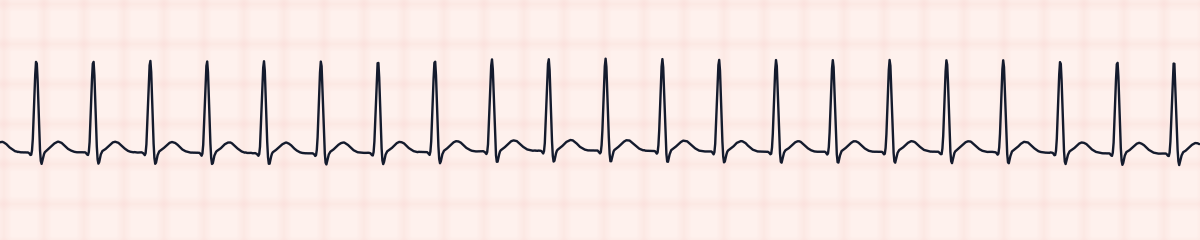
Both are narrow, regular and without visible P waves, and on a single strip they can be impossible to separate. SVT is usually faster than 150 and starts and stops in one beat. Junctional tachycardia is usually slower and changes rate gradually.
Junctional tachycardia vs. sinus tachycardia
Sinus tachycardia covers the same rates, but each of its beats is led by an upright P wave a normal PR interval ahead. Junctional tachycardia has no such P wave.
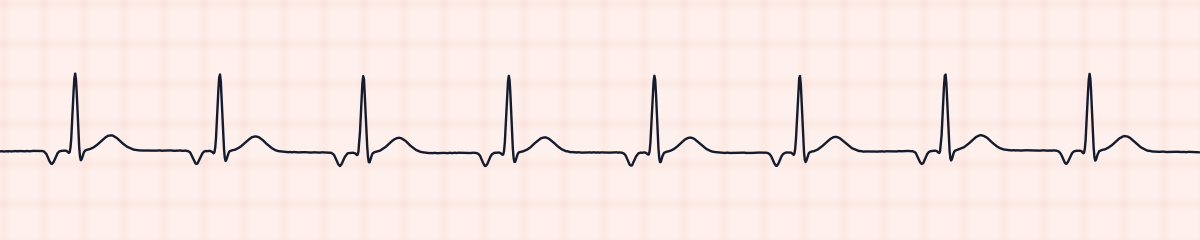
Junctional tachycardia vs. accelerated junctional rhythm
Identical in shape. The line between them is a rate of 100: at or below it is accelerated junctional rhythm, above it is junctional tachycardia.
Practice: junctional tachycardia or a look-alike?
Five strips. Some show junctional tachycardia; the others are the rhythms most often confused with it.
Strip 1 of 5
Lead II · 25 mm/s · 6 s
Causes of junctional tachycardia
- Digoxin toxicity
- The first days after heart surgery, especially in children
- Myocardial infarction and myocarditis
- High levels of adrenaline-like drugs or stimulants
- Low potassium
- Occasionally an inherited tendency
Why it matters
A fast rate from the junction costs the patient twice: the ventricles have less time to fill, and the atria no longer contract just ahead of them. After heart surgery that combination can drop cardiac output sharply. In a patient on digoxin, a regular narrow tachycardia with no P waves is a classic sign that the drug level is too high.
What is done for junctional tachycardia
- Assess blood pressure, perfusion and symptoms.
- Ask about digoxin; expect a drug level and electrolytes to be ordered.
- Stop or hold the likely cause, as ordered.
- A beta blocker or a calcium channel blocker may be prescribed to slow the rate.
- Because the tissue is overactive rather than looping, vagal maneuvers, adenosine and cardioversion often do not end it.
- Tell the provider, and send a strip showing how the tachycardia began if you have one.
Study summary, not a protocol. Follow current American Heart Association guidelines and your facility’s policies. See the medical disclaimer.
Common mistakes with junctional tachycardia
- Labeling it SVT and expecting adenosine to fix it.
- Overlooking a small inverted P wave tucked against the QRS.
- Calling it sinus tachycardia without finding a P wave to prove it.
Questions about junctional tachycardia
What rate is junctional tachycardia?
Faster than 100 beats per minute, typically 100 to 180. Slower versions have their own names: accelerated junctional rhythm from 60 up to 100, and junctional escape rhythm from 40 to 60.
How do you tell junctional tachycardia from SVT?
It is difficult on one strip, since both are narrow and regular without clear P waves. Junctional tachycardia is usually under 150, speeds up and slows down gradually, and often has an obvious cause such as digoxin or recent surgery. SVT is usually over 150 and starts and stops abruptly.
What causes junctional tachycardia?
Overactive pacemaker cells in the AV junction. The usual triggers are digoxin toxicity, recent cardiac surgery, a heart attack, inflammation of the heart and stimulant drugs.