Sinus rhythms
Normal sinus rhythm EKG strip
Normal sinus rhythm (NSR) is the heart’s normal rhythm. On an EKG strip it is regular, at 60 to 100 beats per minute, with one upright P wave before every QRS complex, a PR interval of 0.12 to 0.20 seconds and a QRS narrower than 0.12 seconds. Every other rhythm is described by how it departs from this one.
Criteria from the American Heart Association guidelines and published ECG standards · Every strip checked by measurement · Sources and method · Updated November 15, 2026
- Rate
- 60–100
- PR interval
- 0.12–0.20 s
- QRS
- < 0.12 s
How to identify normal sinus rhythm in five steps
Ask the same five questions of every strip. The right-hand column is what each one finds on the strip above.
1Rate
Between 60 and 100. Below 60 with everything else normal is sinus bradycardia; above 100 is sinus tachycardia.
88 bpm
2Rhythm
Regular. The R-R intervals match to within about one small square. A slight speeding and slowing with breathing is sinus arrhythmia, which is normal in young people.
Regular
3P waves
Upright in lead II, rounded, all the same shape, and exactly one in front of each QRS.
1 per QRS
4PR interval
0.12 to 0.20 s (3 to 5 small squares), and the same on every beat.
0.16 s
5QRS
Narrower than 0.12 s (3 small squares).
0.08 s
What is happening in the heart
Each beat starts in the sinoatrial (SA) node, high in the right atrium. The impulse spreads across both atria, which draws the P wave. It is held briefly at the AV node, which is the flat stretch of the PR interval, and then runs down the bundle branches so that both ventricles fire together, which draws a narrow QRS. The T wave is the ventricles recharging.
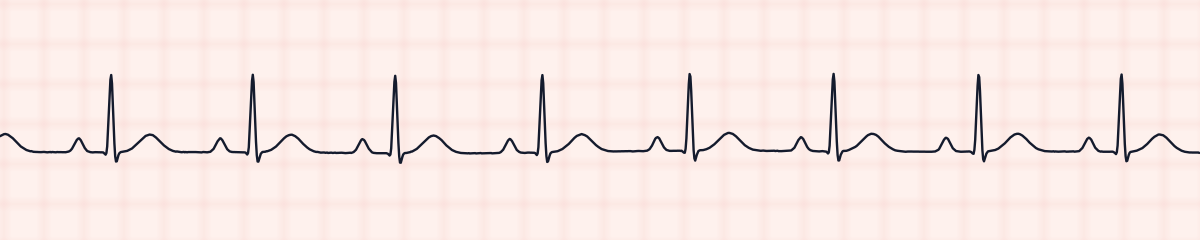
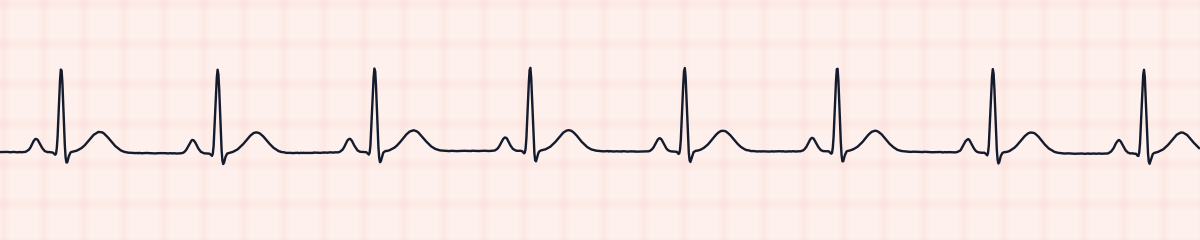
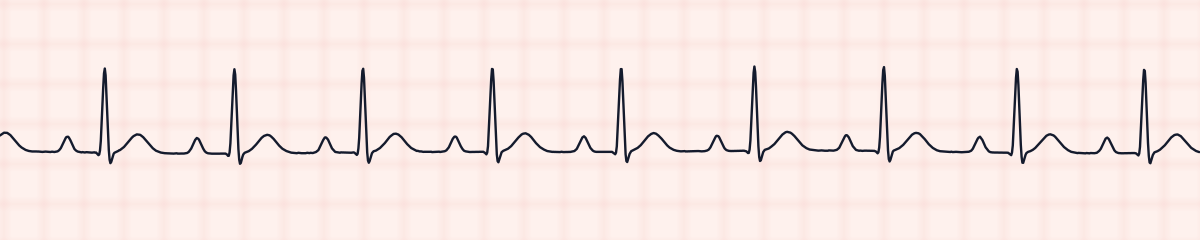
More normal sinus rhythm strips: no two are the same
A rhythm is a set of rules, not a picture. These three strips all meet the rules for normal sinus rhythm, with different numbers.
What normal sinus rhythm gets mistaken for
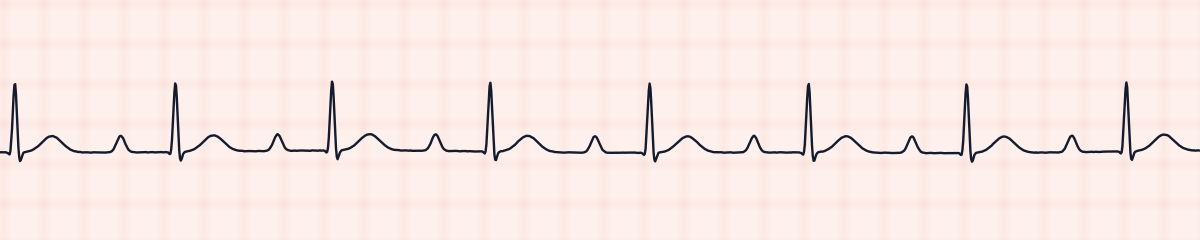
Normal sinus rhythm vs. first-degree AV block
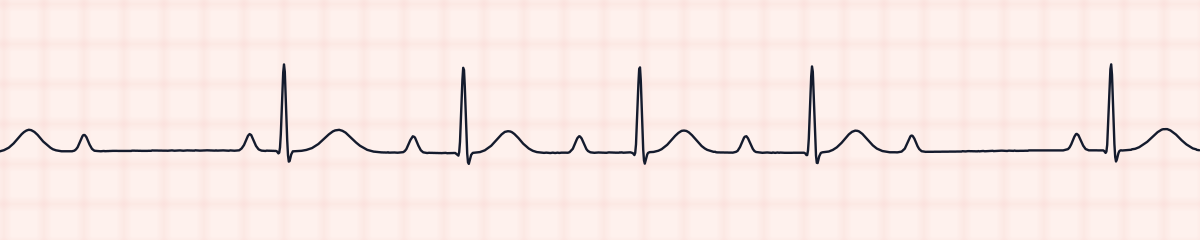
First-degree AV block looks identical until you measure. Its PR interval is longer than 0.20 s, more than one large square, on every beat. If you do not measure the PR, you will call it normal.
Normal sinus rhythm vs. second-degree AV block, type I (Wenckebach)
A Wenckebach strip can look like sinus rhythm for three or four beats in a row. Look along the whole strip for a pause, then check whether there is a P wave sitting in that pause with no QRS after it.
Normal sinus rhythm vs. pulseless electrical activity (PEA)
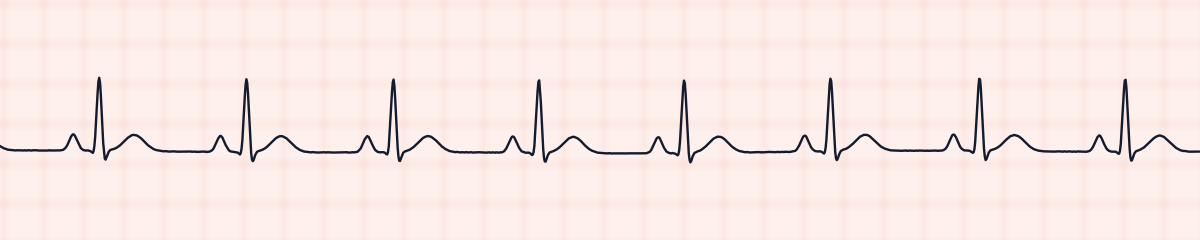
Pulseless electrical activity can be this exact tracing. The monitor shows the electricity, not the pumping. A normal-looking rhythm in a patient with no pulse is PEA, and it is treated as cardiac arrest.
Practice: normal sinus rhythm or a look-alike?
Five strips. Some show normal sinus rhythm; the others are the rhythms most often confused with it.
Strip 1 of 5
Lead II · 25 mm/s · 6 s
Why normal sinus rhythm matters
Normal sinus rhythm is the yardstick. You cannot say a PR interval is long or a QRS is wide unless you know the normal numbers cold. It also carries a warning worth learning early: the strip tells you about electrical activity only. It does not tell you that the heart is pumping.
- It is the healthy baseline, so there is no cause to look for.
- It is also the rhythm you hope to see return after a successful cardioversion or defibrillation.
What is done for normal sinus rhythm
- No treatment for the rhythm itself.
- Assess the patient, not the monitor: a normal rhythm does not rule out chest pain, low blood pressure or cardiac arrest.
- When you document a strip, write down the rate, PR interval and QRS width, not only the name.
Study summary, not a protocol. Follow current American Heart Association guidelines and your facility’s policies. See the medical disclaimer.
Common mistakes with normal sinus rhythm
- Naming a strip normal sinus rhythm from its overall look without measuring the PR interval.
- Calling a regular rhythm at 55 or 105 normal sinus rhythm. The pattern is sinus, but the name changes with the rate.
- Treating muscle tremor or a loose electrode as an arrhythmia. Artifact does not march out; real complexes do.
Questions about normal sinus rhythm
What are the criteria for normal sinus rhythm?
Rate 60 to 100 per minute, regular R-R intervals, one upright P wave before every QRS, a constant PR interval of 0.12 to 0.20 seconds, and a QRS narrower than 0.12 seconds. All five must be true.
Is sinus rhythm the same as normal sinus rhythm?
Not quite. Sinus rhythm means the beat starts in the SA node. Normal sinus rhythm adds that the rate is 60 to 100. Sinus bradycardia and sinus tachycardia are sinus rhythms that are too slow or too fast to be called normal.
Can a patient in normal sinus rhythm have no pulse?
Yes. That is pulseless electrical activity. The EKG records electrical signals, and the heart can produce a normal-looking signal without contracting effectively. Always check the patient.