Ventricular rhythms
Ventricular bigeminy EKG strip
Ventricular bigeminy is a rhythm in which every other beat is a premature ventricular contraction. On an EKG strip the beats come in pairs: a normal sinus beat with a P wave and a narrow QRS, then an early wide beat with no P wave, then a pause, and the pair repeats.
Criteria from the American Heart Association guidelines and published ECG standards · Every strip checked by measurement · Sources and method · Updated November 15, 2026
- Rate
- Count every QRS
- PR interval
- Normal on the sinus beats
- QRS
- Alternates narrow and wide
How to identify ventricular bigeminy in five steps
Ask the same five questions of every strip. The right-hand column is what each one finds on the strip above.
1Rate
Count every QRS in 6 seconds and multiply by 10. The pulse you feel may be only half of that.
~60 bpm
2Rhythm
Irregular in a fixed pattern: short interval, long interval, repeating.
Irregular, in pairs
3P waves
Present before each narrow beat, absent before each wide one.
On every other beat
4PR interval
Normal and constant on the sinus beats.
0.15 s on sinus beats
5QRS
Alternates: narrow, then 0.12 s or wider, then narrow again.
0.08 s, then 0.17 s
What is happening in the heart
After each normal beat, an irritable focus in the ventricle fires at a fixed interval, producing a PVC. The compensatory pause that follows gives the ventricles a long time to recover, and that long recovery is itself what sets up the next PVC after the next normal beat. So the pattern tends to sustain itself once it starts. When every third beat is a PVC the pattern is called trigeminy, and every fourth, quadrigeminy.
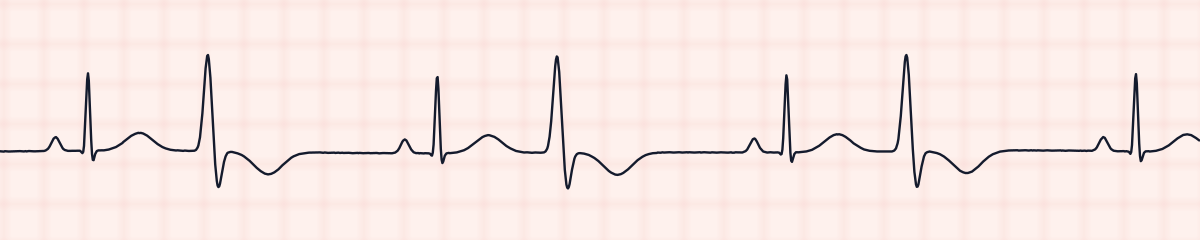
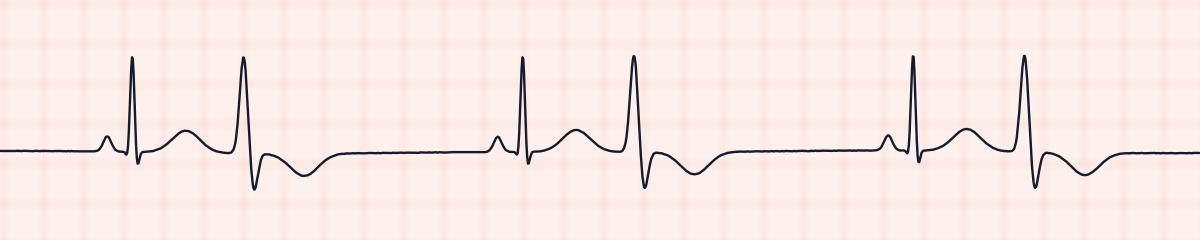
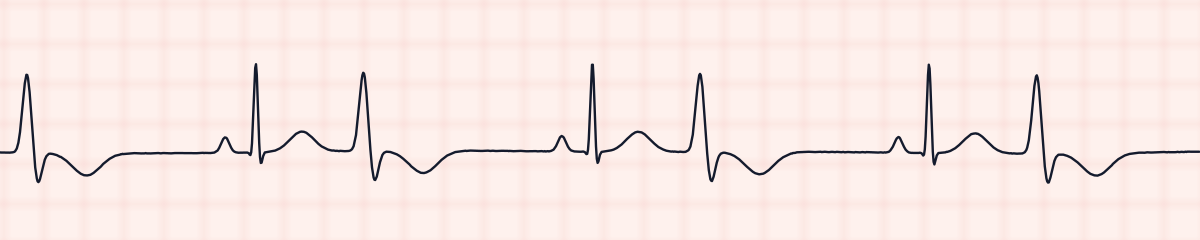
More ventricular bigeminy strips: no two are the same
A rhythm is a set of rules, not a picture. These three strips all meet the rules for ventricular bigeminy, with different numbers.
What ventricular bigeminy gets mistaken for
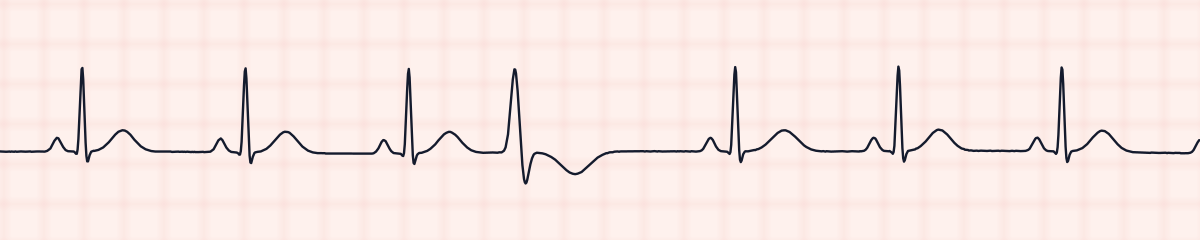
Ventricular bigeminy vs. premature ventricular contractions (PVCs)
With occasional PVCs there are runs of two or more normal beats between them. In bigeminy there is never more than one normal beat before the next PVC.
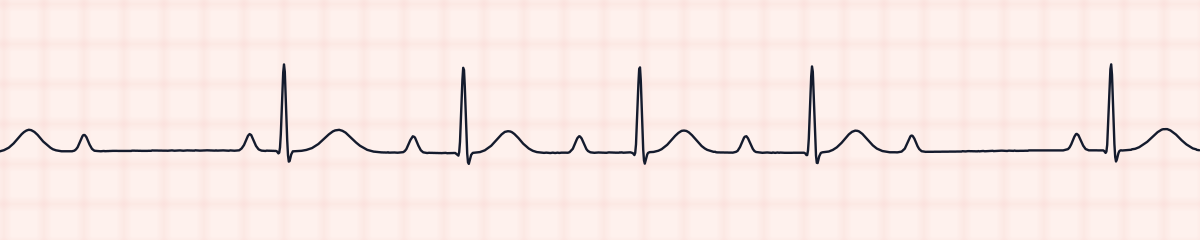
Ventricular bigeminy vs. second-degree AV block, type I (Wenckebach)
Wenckebach also groups its beats in sets separated by pauses. Every QRS in Wenckebach is narrow and follows a P wave. In bigeminy the second beat of each pair is wide and has no P wave.
Ventricular bigeminy vs. atrial fibrillation
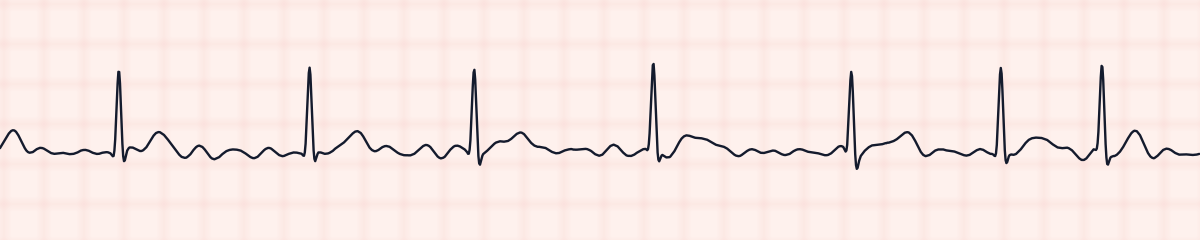
Both look irregular at a glance. Bigeminy repeats the same short-long pattern and has P waves before the narrow beats. Atrial fibrillation never repeats and has no P waves.
Practice: ventricular bigeminy or a look-alike?
Five strips. Some show ventricular bigeminy; the others are the rhythms most often confused with it.
Strip 1 of 5
Lead II · 25 mm/s · 6 s
Causes of ventricular bigeminy
- Myocardial ischemia or a recent heart attack
- Low potassium or low magnesium
- Hypoxia
- Digoxin toxicity, for which bigeminy is a classic sign
- Stimulants, including caffeine
- Cardiomyopathy and heart failure
Why it matters
Half of the heart’s beats are premature and may be too weak to open the aortic valve. The monitor may show 80 while the patient’s effective pulse is 40, with the fall in cardiac output that implies. Sustained bigeminy also means the ventricle is persistently irritable.
What is done for ventricular bigeminy
- Take an apical and a radial pulse and compare them with the monitor; document the difference.
- Assess blood pressure and symptoms of low output.
- Check oxygen saturation, potassium and magnesium, and whether the patient is on digoxin.
- Report new bigeminy.
- Treatment is of the cause; the pattern often stops when the trigger is corrected.
Study summary, not a protocol. Follow current American Heart Association guidelines and your facility’s policies. See the medical disclaimer.
Common mistakes with ventricular bigeminy
- Recording the monitor rate as the pulse without feeling one.
- Seeing grouped beats and calling it a heart block without measuring the QRS of each beat.
- Counting only the narrow beats and reporting the rhythm as a bradycardia.
Questions about ventricular bigeminy
What is ventricular bigeminy?
A repeating pattern of one normal beat followed by one PVC. Every second beat on the strip is a premature ventricular beat.
Why is the pulse slower than the monitor rate in bigeminy?
The PVC comes so early that the ventricle has not had time to fill, so it may eject too little blood to be felt as a pulse. Only the normal beats are felt, giving a pulse of about half the electrical rate.
What is the difference between bigeminy and trigeminy?
In bigeminy every second beat is a PVC. In trigeminy every third beat is a PVC, so two normal beats come between them.
Is ventricular bigeminy serious?
It can be well tolerated, but it deserves attention: it reduces the number of effective beats, and it is a sign of an irritable ventricle. A new occurrence is reported and the cause is looked for.