Supraventricular rhythms
Atrial flutter EKG strip
Atrial flutter is a rhythm in which the atria beat in a rapid, organized circuit at 250 to 350 times per minute. On an EKG strip it shows sawtooth flutter waves with no flat baseline between them, and narrow QRS complexes after every second, third or fourth wave. The ventricular rhythm is often regular.
Criteria from the American Heart Association guidelines and published ECG standards · Every strip checked by measurement · Sources and method · Updated November 15, 2026
- Rate
- Atrial 250–350
- PR interval
- Not measurable
- QRS
- < 0.12 s
How to identify atrial flutter in five steps
Ask the same five questions of every strip. The right-hand column is what each one finds on the strip above.
1Rate
Atrial rate 250 to 350. The ventricular rate is that number divided by the conduction ratio: about 150 at 2:1, 100 at 3:1, 75 at 4:1.
76 bpm
2Rhythm
Regular when the conduction ratio is fixed, irregular when it varies.
Regular
3P waves
None. Sawtooth flutter (F) waves replace them, best seen in lead II.
Flutter waves, 304/min
4PR interval
Not measured.
Not measurable
5QRS
Narrower than 0.12 s. Flutter waves running into it can make it look slightly wider.
0.08 s
What is happening in the heart
A single electrical impulse circles the right atrium continuously, about 300 laps per minute. Each lap draws one flutter wave, and because the circuit never rests, the baseline never goes flat. The AV node cannot conduct that fast, so it passes only some impulses: every second one (2:1), every third (3:1) or every fourth (4:1). When the ratio holds steady the ventricles are regular; when it changes they are irregular.
More atrial flutter strips: no two are the same
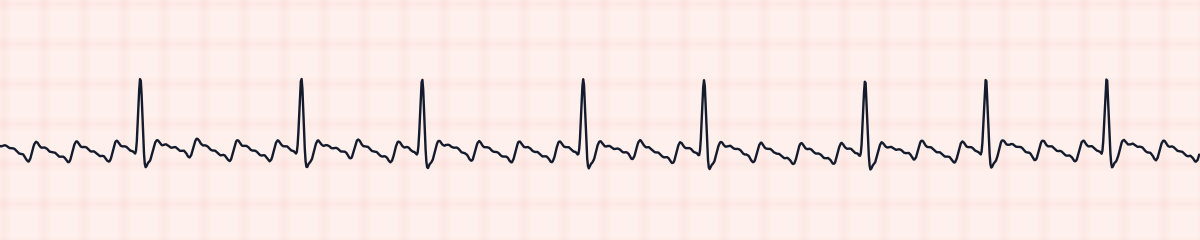
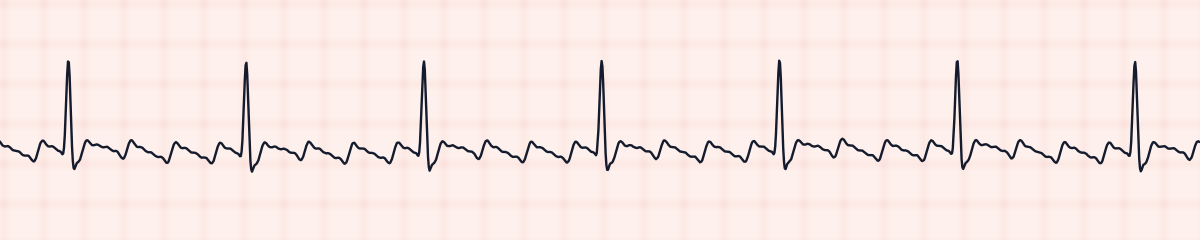
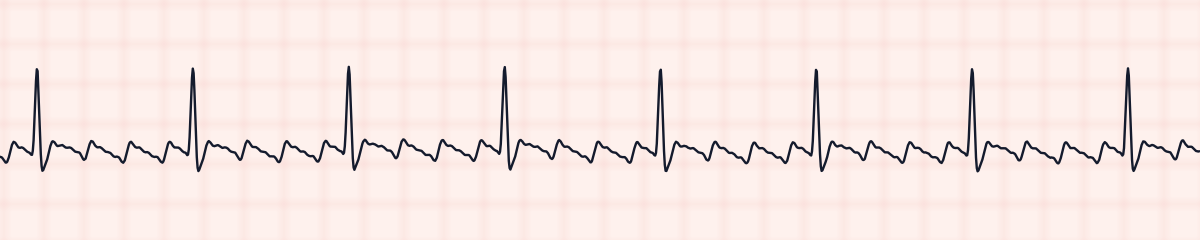
A rhythm is a set of rules, not a picture. These three strips all meet the rules for atrial flutter, with different numbers.
What atrial flutter gets mistaken for
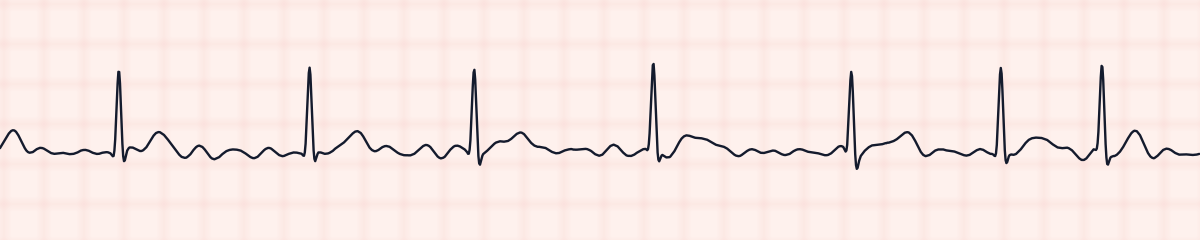
Atrial flutter vs. atrial fibrillation
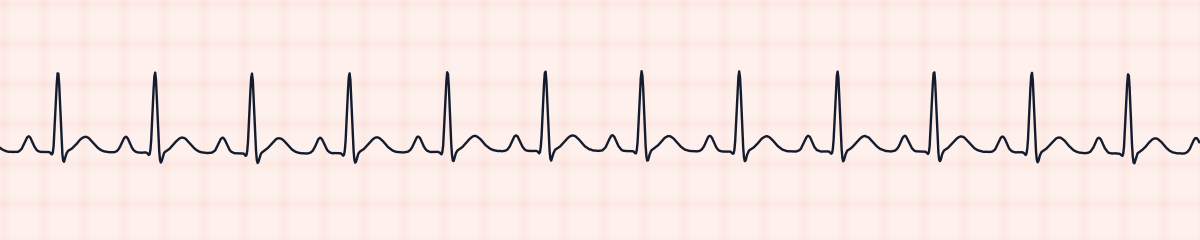
Atrial fibrillation has a fine, disorganized baseline and R-R intervals with no pattern. Flutter has identical, evenly spaced sawtooth waves that you can count, and its R-R intervals are equal or come in a few set lengths.
Atrial flutter vs. supraventricular tachycardia (SVT)
A narrow regular tachycardia at almost exactly 150 should make you suspect flutter with 2:1 conduction. Look for a second flutter wave hidden in the T wave or the end of the QRS.
Atrial flutter vs. sinus tachycardia
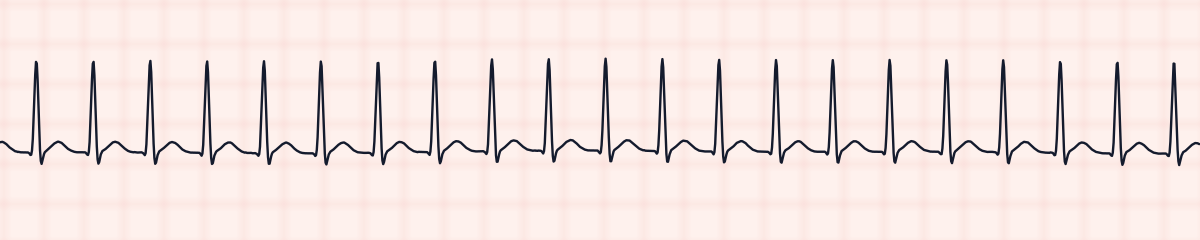
Sinus tachycardia has one rounded P wave per QRS and a flat stretch of baseline. Flutter has two or more pointed waves per QRS and no flat baseline anywhere.
Practice: atrial flutter or a look-alike?
Five strips. Some show atrial flutter; the others are the rhythms most often confused with it.
Strip 1 of 5
Lead II · 25 mm/s · 6 s
Causes of atrial flutter
- Coronary artery disease and heart failure
- Heart valve disease
- Recent cardiac surgery
- Chronic lung disease and pulmonary embolism
- Overactive thyroid
- Heavy alcohol use
- High blood pressure
Why it matters
Flutter carries the same two risks as atrial fibrillation. The atria do not empty properly, so clots can form and cause a stroke, and a fast ventricular rate cuts cardiac output. The 2:1 form is the most troublesome, because a steady rate of 150 is poorly tolerated for long and is easily misread as another rhythm.
What is done for atrial flutter
- Assess stability: blood pressure, chest pain, breathlessness, mental status.
- Unstable: synchronized cardioversion, which often works at low energy.
- Stable: rate control with a beta blocker or diltiazem.
- Anticoagulation is considered, as for atrial fibrillation.
- Catheter ablation of the circuit is often used to prevent it coming back.
- Report new atrial flutter.
Study summary, not a protocol. Follow current American Heart Association guidelines and your facility’s policies. See the medical disclaimer.
Common mistakes with atrial flutter
- Reading 2:1 flutter as sinus tachycardia or SVT because one flutter wave is hidden.
- Mistaking flutter waves for T waves or for artifact.
- Giving the atrial rate as the heart rate. Report both the atrial and the ventricular rate.
Questions about atrial flutter
What does atrial flutter look like on an EKG strip?
A sawtooth baseline: identical, pointed flutter waves at about 300 per minute with no flat line between them, and narrow QRS complexes at regular intervals among them.
What does 4:1 atrial flutter mean?
It is the conduction ratio: four flutter waves for every QRS. With an atrial rate of 300, 4:1 conduction gives a ventricular rate of 75. With 2:1 conduction the ventricular rate is about 150.
What is the difference between atrial flutter and atrial fibrillation?
Flutter is organized: one circuit, uniform sawtooth waves, and often a regular ventricular rhythm. Fibrillation is disorganized: a chaotic baseline and an irregularly irregular ventricular rhythm.
Is atrial flutter regular or irregular?
Either. If the AV node conducts at a constant ratio, the ventricular rhythm is regular. If the ratio changes from beat to beat, which is called variable conduction, it is irregular.