Paced rhythms
Pacemaker failure to capture EKG strip
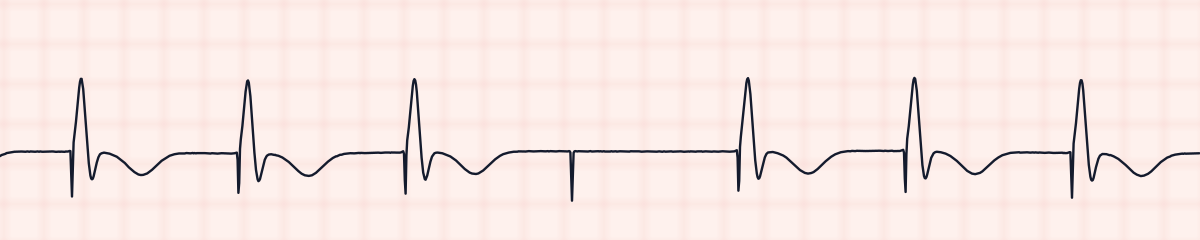
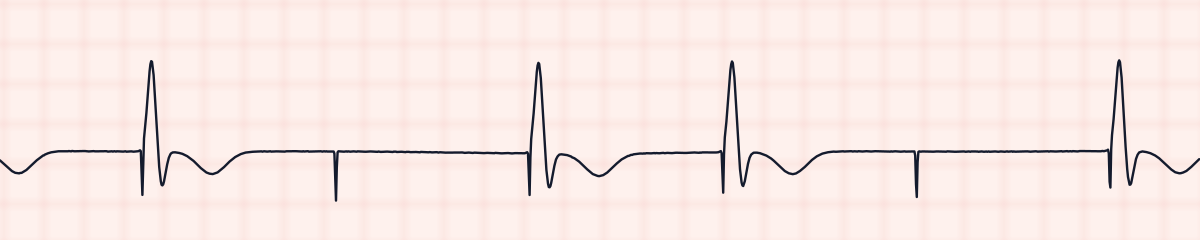
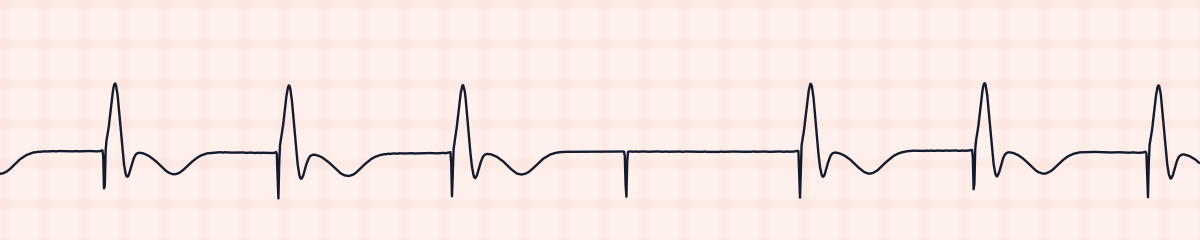
Failure to capture is a pacemaker malfunction in which the pacemaker fires but the heart does not respond. On an EKG strip a pacing spike appears on time and nothing follows it: no QRS after a ventricular spike, or no P wave after an atrial spike. The result is a missed beat.
Criteria from the American Heart Association guidelines and published ECG standards · Every strip checked by measurement · Sources and method · Updated November 15, 2026
- Rate
- Below the set rate
- PR interval
- None
- QRS
- ≥ 0.12 s on captured beats
How to identify failure to capture in five steps
Ask the same five questions of every strip. The right-hand column is what each one finds on the strip above.
1Rate
Lower than the set rate, because some paced beats are missing.
~60 bpm
2Rhythm
Regular spikes; the QRS complexes are regular except where one is missing.
Regular, with a missed beat
3P waves
None with ventricular pacing.
None
4PR interval
None.
None; one spike has no QRS
5QRS
Wide after the spikes that capture. Absent after the spike that does not.
0.17 s, wide
What is happening in the heart
For a pacing pulse to work, it has to be strong enough, and delivered in the right place, to trigger the muscle at the tip of the lead. Capture is lost when the pulse is too weak for the tissue, when the lead has moved or broken, or when the tissue has become harder to stimulate. The generator still fires on schedule, which is why the spike is there, but the muscle does not depolarize.
More failure to capture strips: no two are the same
A rhythm is a set of rules, not a picture. These three strips all meet the rules for failure to capture, with different numbers.
What failure to capture gets mistaken for
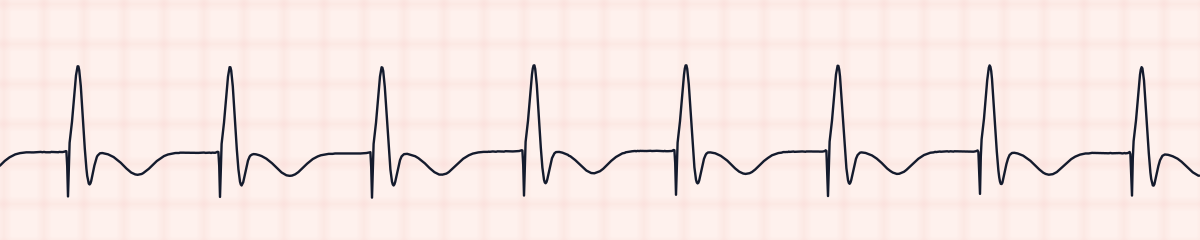
Failure to capture vs. ventricular paced rhythm
In a normally working paced rhythm every spike is followed by a QRS. Walk along the strip spike by spike; one with nothing after it is failure to capture.
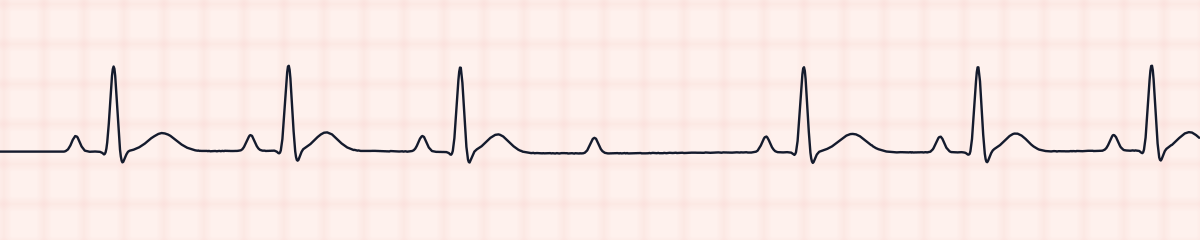
Failure to capture vs. second-degree AV block, type II (Mobitz II)
Mobitz II also drops a QRS suddenly, but what stands alone in the gap is a P wave. In failure to capture it is a pacing spike.
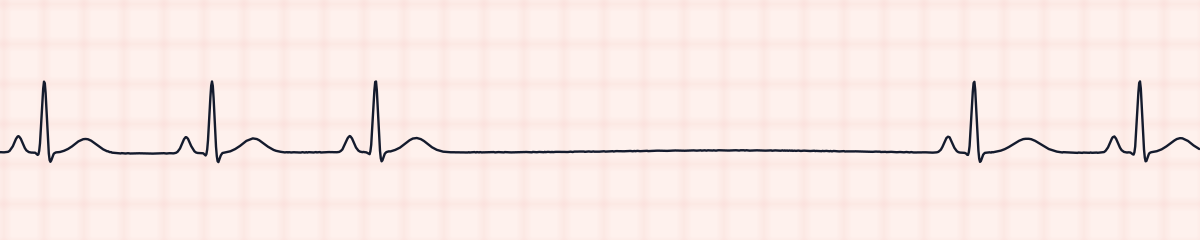
Failure to capture vs. sinus arrest (sinus pause)
A sinus pause is an empty gap. Failure to capture has a spike in the gap.
Practice: failure to capture or a look-alike?
Five strips. Some show failure to capture; the others are the rhythms most often confused with it.
Strip 1 of 5
Lead II · 25 mm/s · 6 s
Causes of failure to capture
- A pacing lead that has moved out of position or fractured
- Output (milliamps) set too low for the patient’s threshold
- A depleted battery
- Scar or swelling at the lead tip
- High potassium, acidosis or hypoxia
- Some antiarrhythmic drugs, which raise the pacing threshold
- A heart attack involving the muscle at the lead tip
Why it matters
The patient has a pacemaker because their own rhythm is too slow or absent. Every spike that fails to capture is a beat they do not get. One missed beat may pass unnoticed; several in a row can mean fainting or cardiac arrest, depending on what rhythm, if any, lies underneath.
What is done for failure to capture
- Check the patient first: responsiveness, pulse, blood pressure.
- Notify the provider at once and save the strip.
- For a temporary pacemaker: check every connection and the battery, and expect an order to increase the output.
- Have transcutaneous pacing ready.
- A symptomatic slow rate is treated as bradycardia while the pacing problem is fixed.
- Anticipate a chest X-ray to check lead position, and electrolyte results.
Study summary, not a protocol. Follow current American Heart Association guidelines and your facility’s policies. See the medical disclaimer.
Common mistakes with failure to capture
- Counting spikes as beats. Only spikes followed by a QRS, and a pulse, count.
- Confusing it with failure to sense, where the spikes fall in the wrong places but may still capture.
- Confusing it with failure to pace, where the spike itself is missing.
Questions about failure to capture
What does failure to capture look like on an EKG?
A pacing spike with no QRS complex after it (or no P wave, for an atrial lead). The spike arrives on time; the heartbeat it should have produced is missing.
What causes failure to capture?
Most often a displaced or broken lead, an output set too low, or a weak battery. Changes in the heart muscle from scarring, high potassium, acidosis or certain drugs can also raise the energy needed to capture.
What is the difference between failure to capture, failure to pace and failure to sense?
Failure to capture: a spike with no response. Failure to pace: no spike when one is due. Failure to sense: the pacemaker does not detect the heart’s own beats, so spikes land at the wrong times, even on top of T waves.
What is the first thing to do for failure to capture?
Assess the patient. If they are symptomatic or pulseless, treat that immediately; then notify the provider and, for a temporary pacemaker, check the connections and output.