AV blocks
First-degree heart block EKG strip
First-degree heart block, or first-degree AV block, is a delay in conduction between the atria and the ventricles. On an EKG strip every P wave is followed by a QRS, but the PR interval is longer than 0.20 seconds (more than one large square) and is the same on every beat. No beats are dropped.
Criteria from the American Heart Association guidelines and published ECG standards · Every strip checked by measurement · Sources and method · Updated November 15, 2026
- Rate
- Underlying rhythm
- PR interval
- > 0.20 s, constant
- QRS
- < 0.12 s
How to identify first-degree heart block in five steps
Ask the same five questions of every strip. The right-hand column is what each one finds on the strip above.
1Rate
Whatever the underlying sinus rate is, usually 60 to 100. The block does not change the rate.
76 bpm
2Rhythm
Regular.
Regular
3P waves
Normal, upright, one for every QRS. At faster rates the P wave can sit on the tail of the T wave before it.
1 per QRS
4PR interval
Longer than 0.20 s and constant. This is the only abnormal finding.
0.28 s
5QRS
Narrower than 0.12 s.
0.08 s
What is happening in the heart
The impulse leaves the SA node normally and reaches the AV node on time, but the AV node holds it longer than usual before passing it on. Every impulse still gets through, so the name “block” is misleading: it is a delay, not a blockage. The ventricles then fire normally, which is why the QRS is narrow.
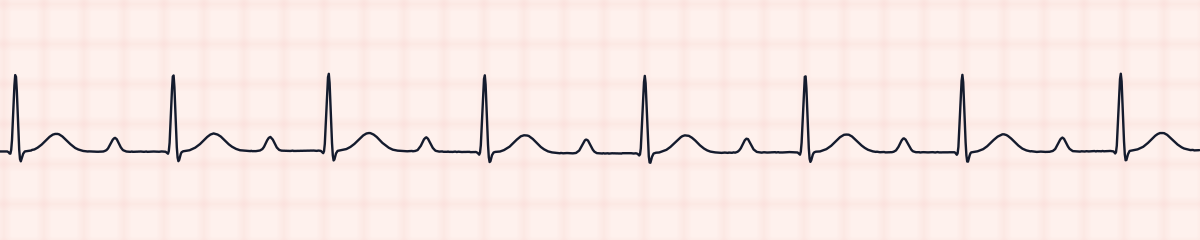
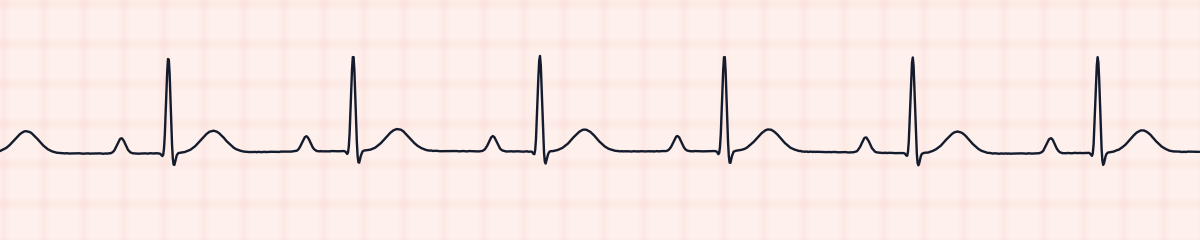
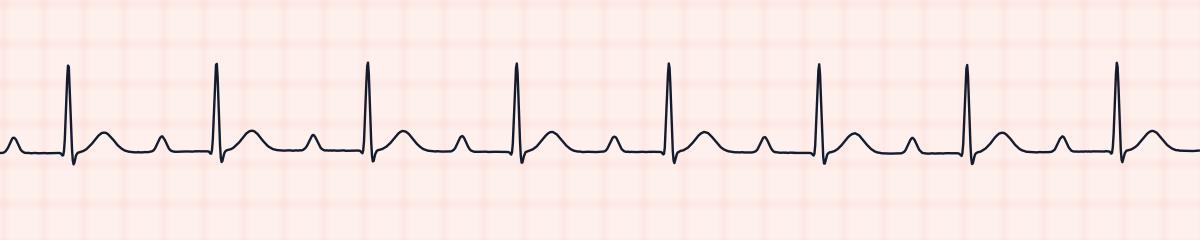
More first-degree heart block strips: no two are the same
A rhythm is a set of rules, not a picture. These three strips all meet the rules for first-degree heart block, with different numbers.
What first-degree heart block gets mistaken for
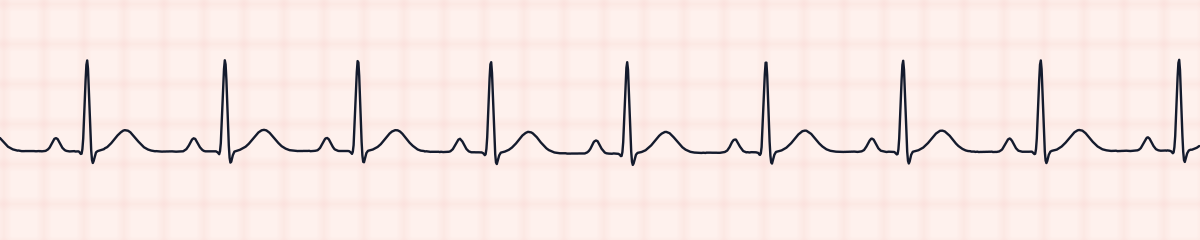
First-degree heart block vs. normal sinus rhythm
Normal sinus rhythm has the same regular one-to-one pattern. The difference is a single measurement: a PR of 0.20 s or less is normal, and longer than 0.20 s is first-degree block. When it is close, count small squares.
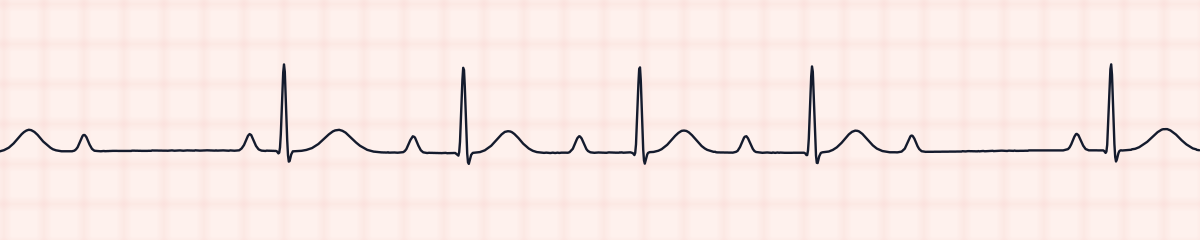
First-degree heart block vs. second-degree AV block, type I (Wenckebach)
Both have long PR intervals. In first-degree block the PR is the same every beat and no QRS is ever missing. In Wenckebach the PR grows from beat to beat until a P wave stands alone.
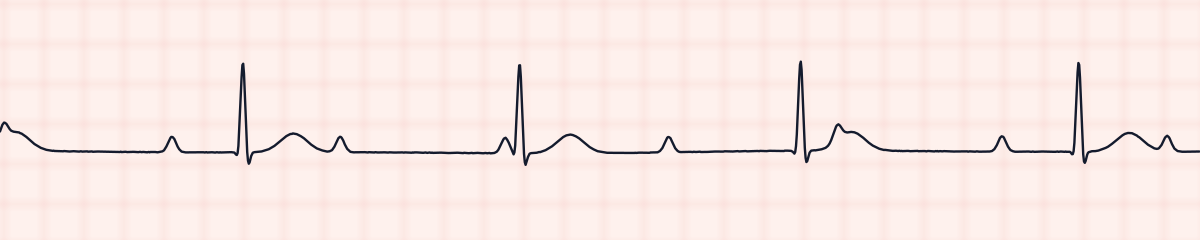
First-degree heart block vs. third-degree (complete) AV block
In complete heart block some P waves happen to land in front of a QRS and can look like a long PR. Measure three in a row: in first-degree block they are identical, in complete block each one is different.
Practice: first-degree heart block or a look-alike?
Five strips. Some show first-degree heart block; the others are the rhythms most often confused with it.
Strip 1 of 5
Lead II · 25 mm/s · 6 s
Causes of first-degree heart block
- High vagal tone, as in athletes and during sleep
- Drugs that slow the AV node: beta blockers, diltiazem, verapamil, digoxin
- Inferior myocardial infarction
- Age-related wear of the conduction system
- Myocarditis and other inflammation of the heart
Why it matters
By itself, first-degree AV block usually causes no symptoms and needs no treatment. It matters as a finding: a PR interval that is new, or that keeps getting longer from one shift to the next, can be the first sign of a drug effect or of a block that is progressing.
What is done for first-degree heart block
- Usually nothing beyond continued monitoring.
- Measure and record the PR interval so the next reader can tell whether it is changing.
- Review the medication list for drugs that slow AV conduction.
- Report a new first-degree block, or a PR that is lengthening over time.
Study summary, not a protocol. Follow current American Heart Association guidelines and your facility’s policies. See the medical disclaimer.
Common mistakes with first-degree heart block
- Not measuring the PR at all, and calling the strip normal sinus rhythm.
- Measuring from the peak of the P wave. The PR interval starts where the P wave begins and ends where the QRS begins.
- Expecting dropped beats. First-degree block never drops a beat; if a QRS is missing, it is second degree or higher.
Questions about first-degree heart block
How long is the PR interval in first-degree heart block?
Longer than 0.20 seconds, which is more than five small squares or one large square at standard paper speed. It stays the same from beat to beat.
Is first-degree heart block dangerous?
Usually not. Most people have no symptoms and need no treatment. It is recorded and watched because it can be caused by medication and, less often, can progress to a higher degree of block.
Why is it called a block if every beat conducts?
The name is historical. Nothing is actually blocked in first-degree AV block: every atrial impulse reaches the ventricles, only later than normal. Many references describe it as first-degree AV delay for that reason.