Sinus rhythms
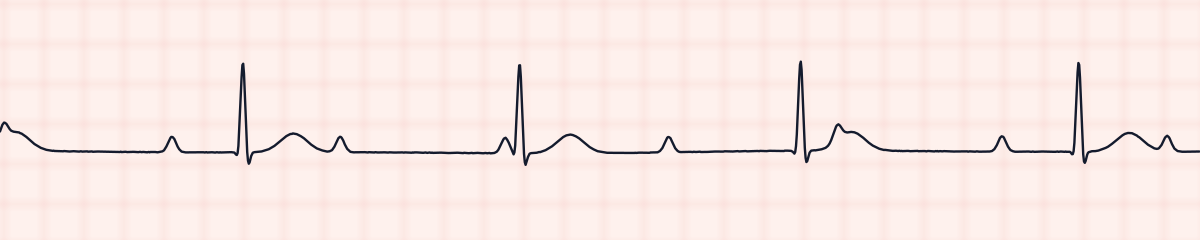
Sinus bradycardia EKG strip
Sinus bradycardia is a sinus rhythm slower than 60 beats per minute. On an EKG strip everything else is normal: the rhythm is regular, an upright P wave comes before every QRS, the PR interval is 0.12 to 0.20 seconds and the QRS is narrow. Only the rate separates it from normal sinus rhythm.
Criteria from the American Heart Association guidelines and published ECG standards · Every strip checked by measurement · Sources and method · Updated November 15, 2026
- Rate
- < 60
- PR interval
- 0.12–0.20 s
- QRS
- < 0.12 s
How to identify sinus bradycardia in five steps
Ask the same five questions of every strip. The right-hand column is what each one finds on the strip above.
1Rate
Below 60. On a 6-second strip that means five QRS complexes or fewer.
48 bpm
2Rhythm
Regular. The long R-R intervals match each other.
Regular
3P waves
Upright and uniform, one ahead of each QRS, exactly as in normal sinus rhythm.
1 per QRS
4PR interval
0.12 to 0.20 s and constant.
0.13 s
5QRS
Narrower than 0.12 s.
0.09 s
What is happening in the heart
The SA node is still the pacemaker and the impulse still follows the normal route through the atria, the AV node and the bundle branches. The node is simply firing less often. That happens when the vagus nerve slows it, when a drug suppresses it, when its blood supply is reduced, or in a fit heart that pumps enough with fewer beats.
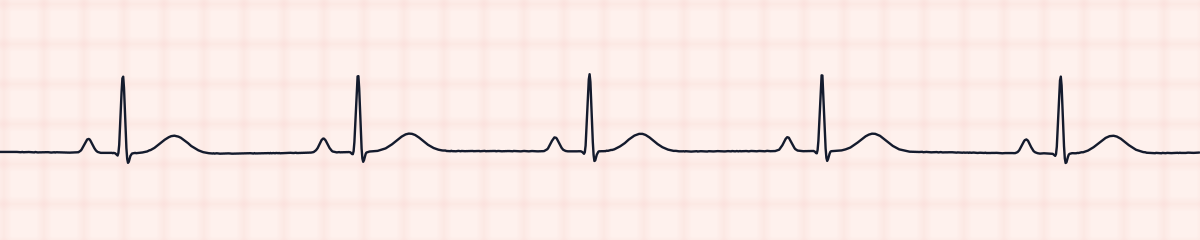
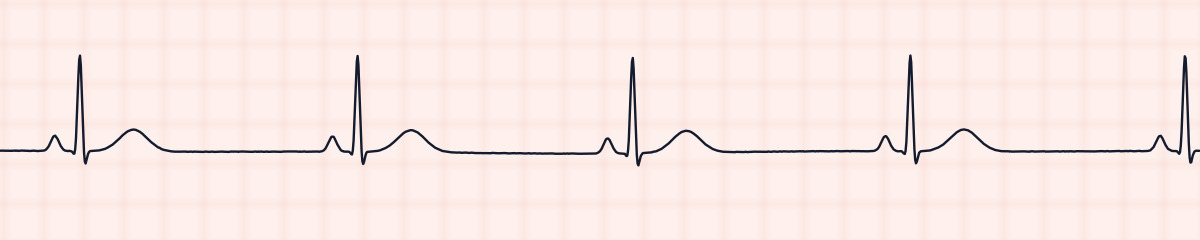
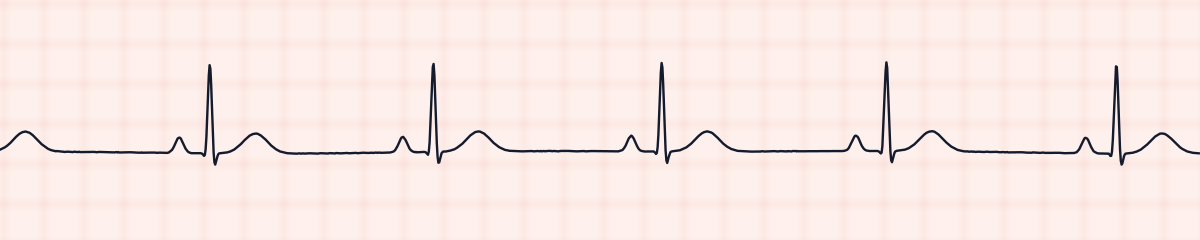
More sinus bradycardia strips: no two are the same
A rhythm is a set of rules, not a picture. These three strips all meet the rules for sinus bradycardia, with different numbers.
What sinus bradycardia gets mistaken for
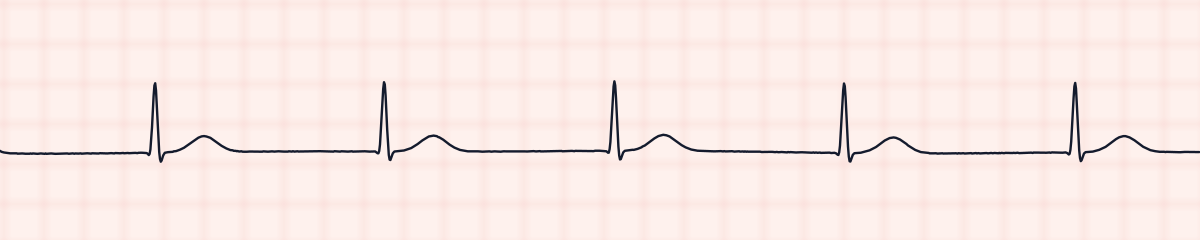
Sinus bradycardia vs. junctional rhythm
A junctional rhythm is also slow, regular and narrow. Look in front of each QRS: sinus bradycardia has an upright P wave there, and a junctional rhythm has none.
Sinus bradycardia vs. third-degree (complete) AV block
Complete heart block with a narrow escape is slow and regular too, and it has P waves. But there are more P waves than QRS complexes and the PR interval never repeats. In sinus bradycardia there is one P wave per QRS at a fixed PR.
Sinus bradycardia vs. normal sinus rhythm
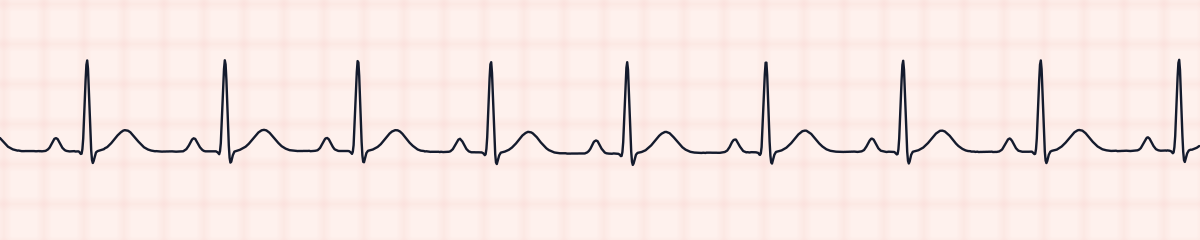
The two are the same pattern. Count the rate: 60 or more is normal sinus rhythm, under 60 is sinus bradycardia. With five or six complexes on the strip, count carefully.
Practice: sinus bradycardia or a look-alike?
Five strips. Some show sinus bradycardia; the others are the rhythms most often confused with it.
Strip 1 of 5
Lead II · 25 mm/s · 6 s
Causes of sinus bradycardia
- Sleep, and a high level of fitness
- Vagal stimulation: vomiting, straining, suctioning, carotid pressure
- Beta blockers, diltiazem, verapamil, digoxin and other rate-slowing drugs
- Inferior myocardial infarction, which can reduce blood flow to the SA node
- Hypothyroidism and hypothermia
- Raised pressure inside the skull
- Severe hypoxia, particularly in children
Why it matters
A slow sinus rate is normal in athletes and in anyone asleep, and it needs nothing. It matters when the rate is too slow to keep up cardiac output. The question is never the number alone but whether the patient is tolerating it: dizziness, confusion, low blood pressure, chest pain and fainting are the signs that it is not.
What is done for sinus bradycardia
- Check the patient before anything else: mental status, blood pressure, skin, symptoms.
- No symptoms: no treatment, just continue to monitor and document.
- Hold and question any dose of a rate-slowing drug, according to the parameters ordered.
- A symptomatic slow rate is treated with atropine first.
- If atropine does not work: transcutaneous pacing, or a dopamine or epinephrine infusion.
- Find and correct the cause, such as hypoxia or a drug level.
Study summary, not a protocol. Follow current American Heart Association guidelines and your facility’s policies. See the medical disclaimer.
Common mistakes with sinus bradycardia
- Treating the number. A rate of 48 in a comfortable patient who is asleep is not an emergency.
- Missing absent P waves and calling a junctional rhythm sinus bradycardia.
- Counting only large squares between two beats when the strip shows few beats; confirm with the 6-second count.
Questions about sinus bradycardia
What heart rate is sinus bradycardia?
A sinus rhythm below 60 beats per minute. Many healthy adults have resting rates in the 50s, and trained athletes can be in the 40s.
Is sinus bradycardia dangerous?
Usually not. It is treated only when it causes symptoms such as dizziness, fainting, low blood pressure, chest pain or shortness of breath, or when it is a sign of something else, such as a drug effect or a heart attack.
What is the first drug for symptomatic bradycardia?
Atropine. It blocks the vagus nerve’s slowing effect on the SA node. If it does not raise the rate, pacing or an infusion of dopamine or epinephrine is used.
How is sinus bradycardia different from a junctional rhythm?
Both are slow and regular with a narrow QRS. Sinus bradycardia has a normal upright P wave before every QRS. In a junctional rhythm the P wave is missing, upside down, or comes after the QRS.