Supraventricular rhythms
Wandering Atrial Pacemaker on an EKG Strip
A wandering atrial pacemaker (WAP) is a rhythm in which the beat is started from several places in turn: the sinus node, other spots in the atria, and sometimes the AV junction. The strip shows P waves of at least three different shapes, a PR interval that changes along with them, and a heart rate below 100 beats a minute.
Criteria from the American Heart Association guidelines and published ECG standards · Every strip checked by measurement · Sources and method · Updated November 15, 2026
- Rate
- < 100
- PR interval
- Changes with the P wave
- QRS
- < 0.12 s
How to identify a wandering atrial pacemaker in five steps
Ask the same five questions of every strip. The right-hand column is what each one finds on the strip above.
1Rate
Under 100; commonly 60 to 100, sometimes slower.
~60 bpm
2Rhythm
Slightly to moderately irregular.
Irregular
3P waves
At least three shapes on one strip, with every QRS owning one.
Three shapes, 1 per QRS
4PR interval
Varies, because each site lies a different distance from the AV node.
Changes with the P wave
5QRS
Narrow, since conduction below the atria is normal.
0.07 s
What is happening in the heart
The shape of a P wave depends on where in the atria the impulse begins and which way it travels. One from the sinus node heads down and to the left and draws an upright, rounded P wave in lead II. One from lower in the atria gives a flatter or more pointed P wave and reaches the AV node sooner, so its PR interval is shorter. One from near the junction travels upward through the atria and draws an inverted P wave with the shortest PR of all. When the lead passes among these sites from beat to beat, the P waves and PR intervals shift with it and the timing becomes slightly uneven.
More wandering atrial pacemaker strips: no two are the same
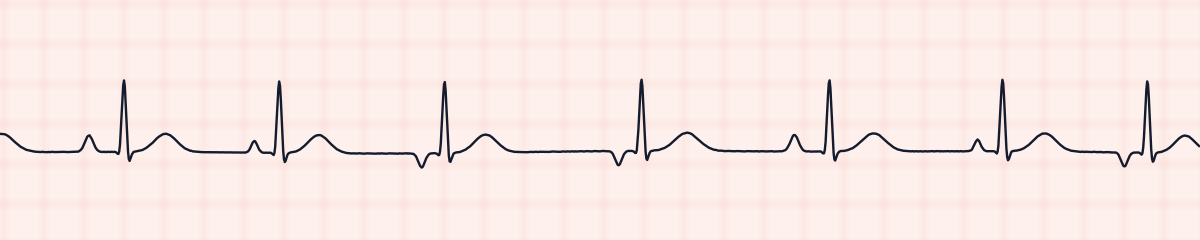
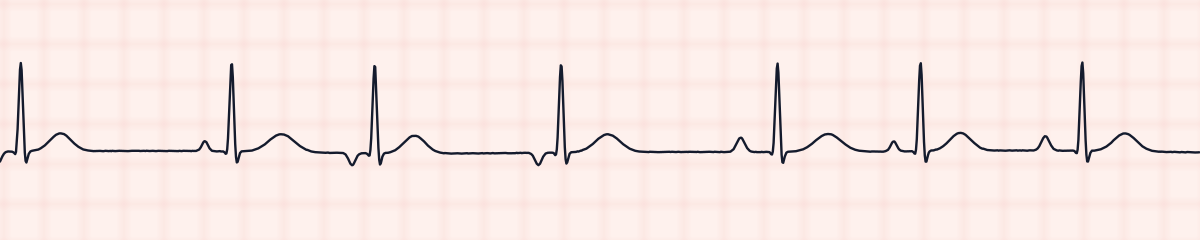
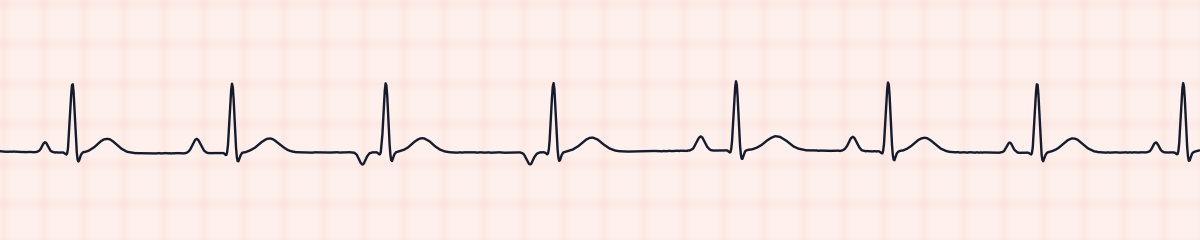
A rhythm is a set of rules, not a picture. These three strips all meet the rules for a wandering atrial pacemaker, with different numbers.
What a wandering atrial pacemaker gets mistaken for
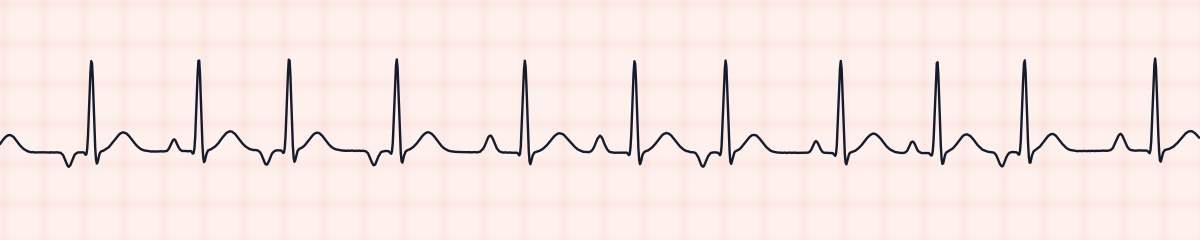
Wandering atrial pacemaker vs. multifocal atrial tachycardia (MAT)
The same rhythm above 100 beats a minute is multifocal atrial tachycardia. Count the rate: nothing else on the strip separates the two.
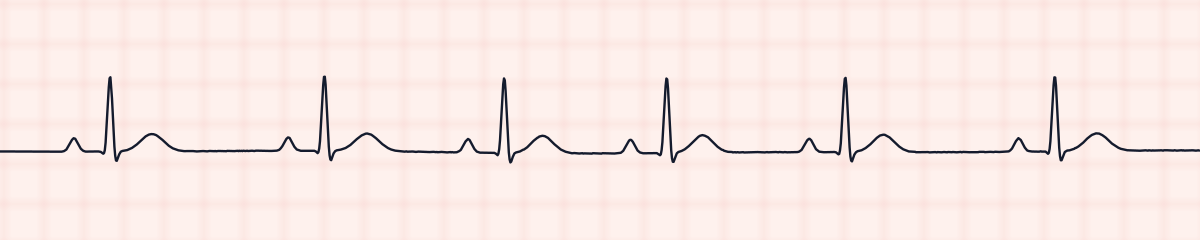
Wandering atrial pacemaker vs. sinus arrhythmia
Sinus arrhythmia is also uneven with a P wave for every QRS, but all of its P waves share one shape and its PR interval never changes.
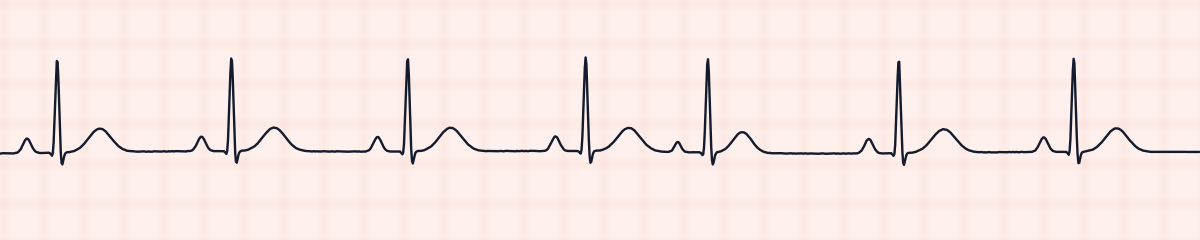
Wandering atrial pacemaker vs. premature atrial contractions (PACs)
With PACs the odd-looking P waves belong to beats that come early, and the rhythm between them is plain sinus. In a wandering pacemaker the shape keeps changing without any beat being clearly premature.
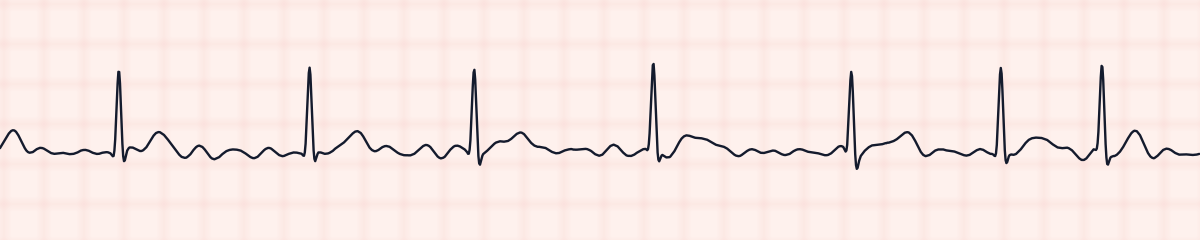
Wandering atrial pacemaker vs. atrial fibrillation
Atrial fibrillation is irregular and has no P waves whatsoever. Here each QRS has a P wave of its own; they just do not match one another.
Practice: a wandering atrial pacemaker or a look-alike?
Five strips. Some show a wandering atrial pacemaker; the others are the rhythms most often confused with it.
Strip 1 of 5
Lead II · 25 mm/s · 6 s
Causes of a wandering atrial pacemaker
- High vagal tone, as in athletes, young people and anyone asleep
- Chronic lung disease
- Digoxin toxicity
- Inflammation or disease of the atria
- Frequently no cause is found
Why it matters
A wandering atrial pacemaker rarely affects cardiac output, and in healthy people it is a normal finding during rest or sleep. Its importance lies mostly in recognizing it. Reported as atrial fibrillation, it would start a conversation about anticoagulation that the patient does not need; and in someone with lung disease it can be an early step toward multifocal atrial tachycardia if the rate climbs.
What is done for a wandering atrial pacemaker
- Usually nothing beyond documenting it and continuing to monitor.
- Ask how the patient feels; symptoms are unusual at these rates.
- When the rhythm is new, review the medication list, digoxin in particular.
- Report a rate that falls low enough to cause symptoms, or one that rises past 100.
Study summary, not a protocol. Follow current American Heart Association guidelines and your facility’s policies. See the medical disclaimer.
Common mistakes with a wandering atrial pacemaker
- Calling it atrial fibrillation because it is irregular, without looking for the P wave that precedes each QRS.
- Stopping after two P wave shapes. Three are required; two can be sinus rhythm with PACs.
- Expecting one constant PR interval and discarding the strip as unreadable when there is not one.
- Overlooking the inverted P waves, which are small and sit close to the QRS.
Questions about a wandering atrial pacemaker
How many P wave shapes are needed for a wandering atrial pacemaker?
At least three different shapes in the same lead. Fewer than that is better explained by a sinus rhythm with occasional premature atrial beats.
What is the difference between a wandering atrial pacemaker and MAT?
Only the rate. Under 100 beats a minute the pattern is called a wandering atrial pacemaker; over 100 it is multifocal atrial tachycardia.
Is a wandering atrial pacemaker serious?
Generally not. It is common in fit, healthy people when vagal tone is high. It needs attention only if the rate causes symptoms or a cause such as digoxin toxicity is suspected.
Why does the PR interval change?
Because the impulse starts in a different place each time. The nearer its starting point is to the AV node, the sooner it gets there and the shorter the PR interval.