Sinus rhythms
Sinus arrest (sinus pause) EKG strip
Sinus arrest, or sinus pause, is a rhythm in which the SA node briefly stops firing. On an EKG strip a normal sinus rhythm is interrupted by a flat stretch with no P wave, no QRS and no T wave, after which the rhythm resumes. The pause is not an exact multiple of the normal P-P interval.
Criteria from the American Heart Association guidelines and published ECG standards · Every strip checked by measurement · Sources and method · Updated November 15, 2026
- Rate
- Underlying sinus rate
- PR interval
- 0.12–0.20 s
- QRS
- < 0.12 s
How to identify sinus arrest in five steps
Ask the same five questions of every strip. The right-hand column is what each one finds on the strip above.
1Rate
The underlying sinus rate is usually normal. The counted rate for the strip is lower because of the missing beats.
~50 bpm
2Rhythm
Regular, then one long gap, then regular again.
Regular, with a 3.0 s pause
3P waves
Normal before each QRS. None at all during the pause.
1 per QRS, none in the pause
4PR interval
0.12 to 0.20 s and constant on the beats that are present.
0.13 s
5QRS
Narrower than 0.12 s.
0.09 s
What is happening in the heart
For a moment the SA node fails to generate an impulse. With no impulse there is no atrial contraction, so no P wave, and nothing reaches the ventricles, so no QRS. The whole heart waits until the SA node recovers or a lower pacemaker fires an escape beat. Short pauses are often called sinus pause and longer ones, of about three seconds or more, sinus arrest; many sources use the two names interchangeably.
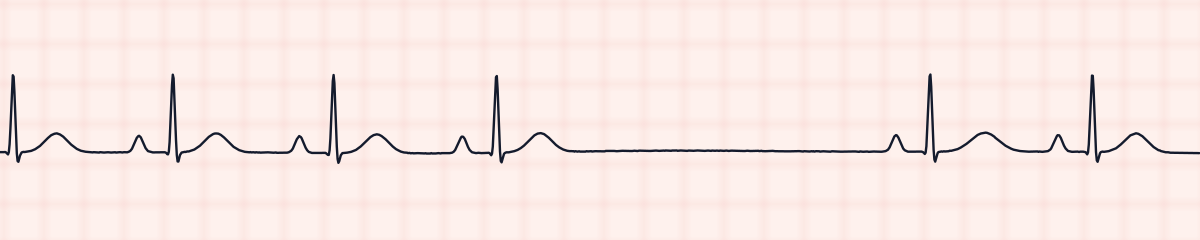
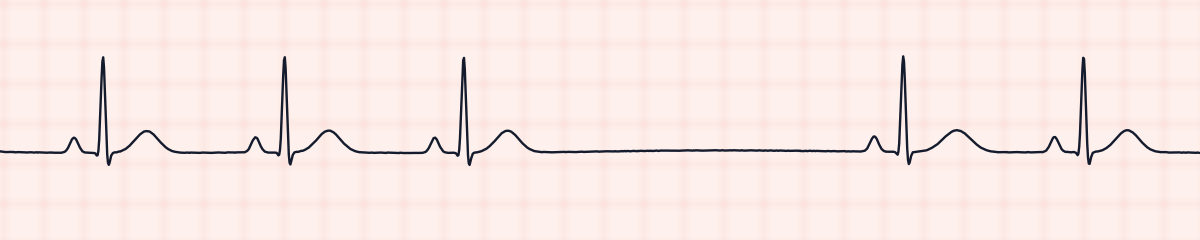
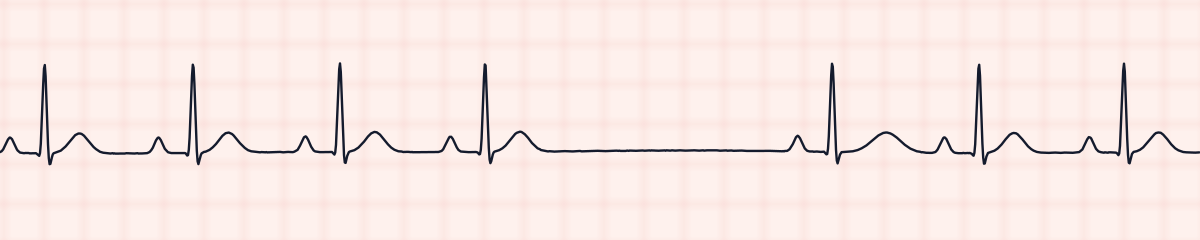
More sinus arrest strips: no two are the same
A rhythm is a set of rules, not a picture. These three strips all meet the rules for sinus arrest, with different numbers.
What sinus arrest gets mistaken for
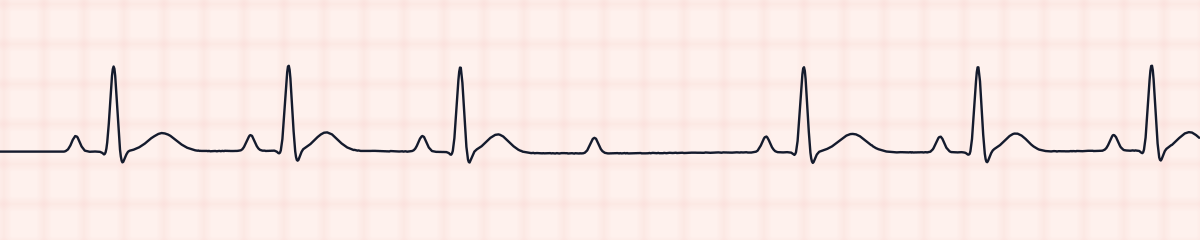
Sinus arrest vs. second-degree AV block, type II (Mobitz II)
Mobitz II also produces a sudden gap in a regular rhythm. Look inside the gap: in Mobitz II a P wave sits there on time with no QRS after it. In sinus arrest the gap is empty.
Sinus arrest vs. premature atrial contractions (PACs)
A premature atrial beat that fails to conduct leaves a pause too. Its early P wave is hiding in the T wave just before the pause, which makes that T wave taller or more pointed than the others.
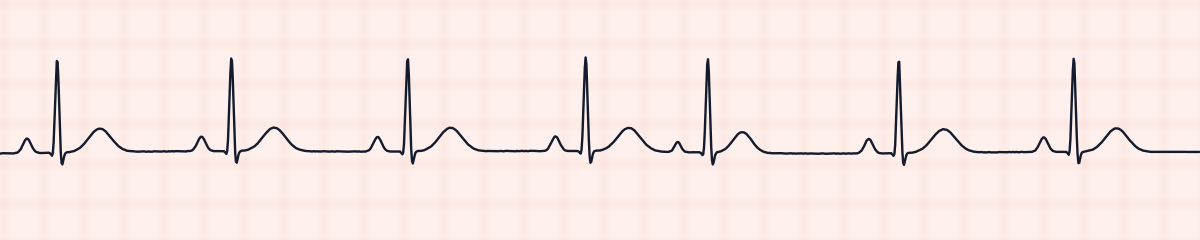
Sinus arrest vs. second-degree AV block, type I (Wenckebach)
Wenckebach pauses repeat in a pattern, each has a P wave in it, and the PR interval lengthens beforehand. A sinus pause has a constant PR interval and no P wave in the gap.
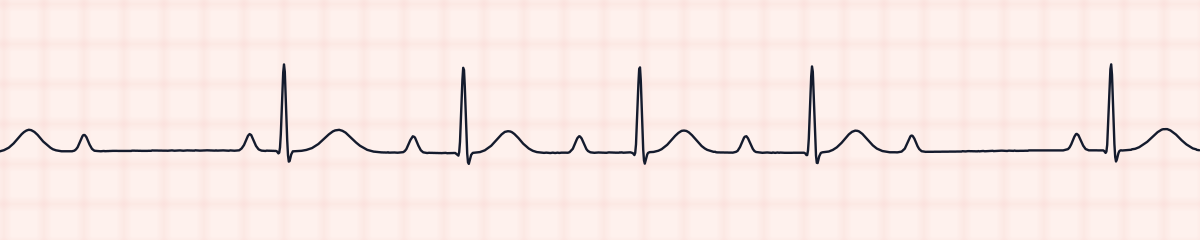
Practice: sinus arrest or a look-alike?
Five strips. Some show sinus arrest; the others are the rhythms most often confused with it.
Strip 1 of 5
Lead II · 25 mm/s · 6 s
Causes of sinus arrest
- Sick sinus syndrome, a wearing out of the SA node with age
- Strong vagal stimulation, including during sleep
- Digoxin, beta blockers and calcium channel blockers
- Myocardial infarction involving the SA node’s blood supply
- High potassium
- Sleep apnea
Why it matters
During the pause nothing is pumped. A short pause may go unnoticed, but a pause of several seconds can cause dizziness or fainting, and repeated pauses point to a failing sinus node. Pauses of three seconds or longer are generally treated as significant and reported.
What is done for sinus arrest
- Measure and record the length of the pause in seconds, and how often pauses occur.
- Assess the patient during and after a pause: dizziness, a fall in blood pressure, loss of consciousness.
- Review medications that slow the SA node and question the next dose.
- Symptomatic pauses are treated as bradycardia: atropine, then pacing.
- Recurrent symptomatic pauses usually lead to a permanent pacemaker.
Study summary, not a protocol. Follow current American Heart Association guidelines and your facility’s policies. See the medical disclaimer.
Common mistakes with sinus arrest
- Not searching the pause for a P wave, and so missing a second-degree block.
- Overlooking a blocked premature atrial beat: check the shape of the T wave just before the gap.
- Reporting “a pause” without its length. The number of seconds is what decides how seriously it is taken.
Questions about sinus arrest
What is the difference between sinus pause and sinus arrest?
They describe the same event, the SA node failing to fire. Many references call a brief one a pause and a longer one, around three seconds or more, an arrest. Others use the terms interchangeably.
How do you measure a sinus pause?
Measure from the R wave before the gap to the R wave after it. At standard paper speed each large square is 0.20 seconds, so 15 large squares is a 3-second pause.
What is the difference between sinus arrest and SA exit block?
In sinus arrest the SA node does not fire, and the pause has no fixed relationship to the normal rhythm. In SA exit block the node fires on time but the impulse does not get out, so the pause is an exact multiple of the normal P-P interval.
When is a sinus pause significant?
A pause of about three seconds or longer, or any pause that causes symptoms, is generally considered significant and should be reported.