Paced rhythms
Ventricular paced rhythm EKG strip
A ventricular paced rhythm is produced by an artificial pacemaker stimulating the ventricles. On an EKG strip each beat begins with a pacing spike, a thin vertical line, followed immediately by a wide QRS (0.12 seconds or more). The rhythm is regular, at the rate the pacemaker is set to.
Criteria from the American Heart Association guidelines and published ECG standards · Every strip checked by measurement · Sources and method · Updated November 15, 2026
- Rate
- Set rate, often 60–80
- PR interval
- None
- QRS
- ≥ 0.12 s
How to identify a paced rhythm in five steps
Ask the same five questions of every strip. The right-hand column is what each one finds on the strip above.
1Rate
The programmed rate, commonly 60 to 80, and constant.
79 bpm
2Rhythm
Regular when the pacemaker is pacing every beat.
Regular
3P waves
None before a ventricular paced beat. With atrial pacing, a spike comes before the P wave instead.
None
4PR interval
None. In dual-chamber pacing the interval between the two spikes is the programmed AV delay.
None; spike before each QRS
5QRS
0.12 s or wider, starting at the spike.
0.16 s, wide
What is happening in the heart
The pacemaker delivers a brief electrical pulse through a lead whose tip rests in the right ventricle. The pulse is so short that it shows on the strip only as a spike. The ventricles are activated from that single point outward through muscle, not through the normal conduction system, so the activation is slow and the QRS is wide, much like a beat that originates in the ventricle. A spike followed by a QRS is called capture.
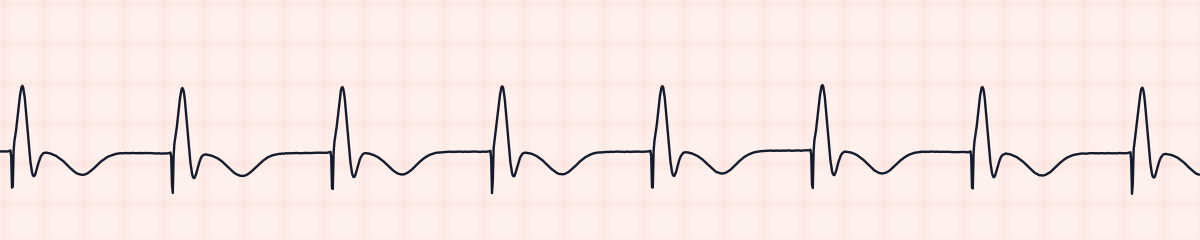
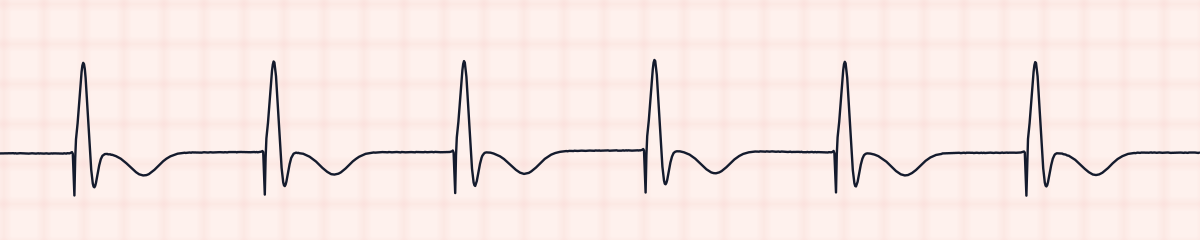
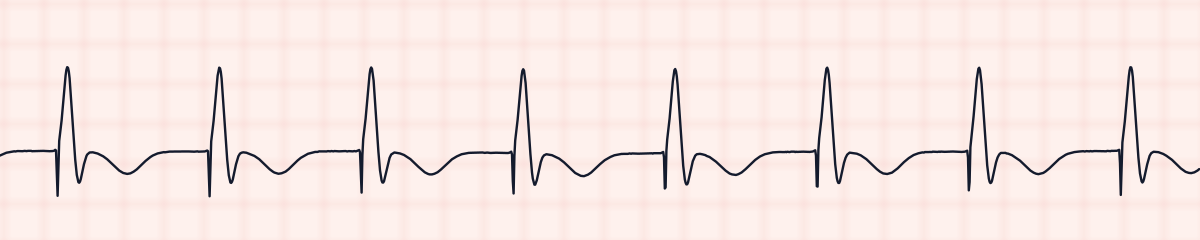
More paced rhythm strips: no two are the same
A rhythm is a set of rules, not a picture. These three strips all meet the rules for a paced rhythm, with different numbers.
What a paced rhythm gets mistaken for
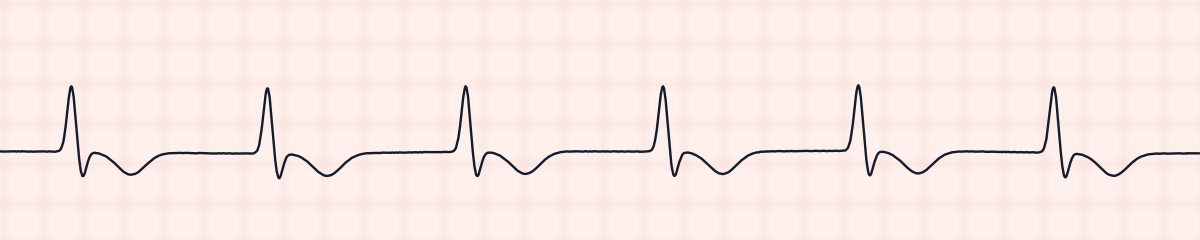
Paced rhythm vs. accelerated idioventricular rhythm (AIVR)
Accelerated idioventricular rhythm is also wide, regular and at a similar rate. It has no spike. Look closely at the first millimeter of each QRS, and turn up the monitor’s pacemaker detection if it has one.
Paced rhythm vs. idioventricular rhythm
An idioventricular rhythm is wide and regular without spikes, and much slower, 20 to 40. A pacemaker is usually set to 60 or more.
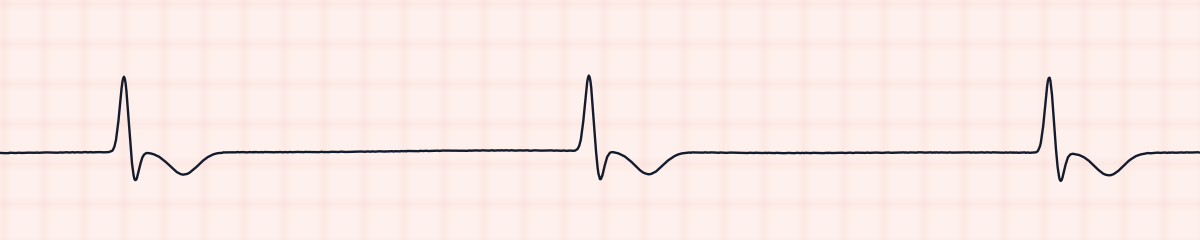
Practice: a paced rhythm or a look-alike?
Five strips. Some show a paced rhythm; the others are the rhythms most often confused with it.
Strip 1 of 5
Lead II · 25 mm/s · 6 s
Why a patient is paced this way
- Symptomatic bradycardia that does not respond to drugs
- Complete heart block and Mobitz II block
- Sick sinus syndrome
- Temporary pacing after cardiac surgery or a heart attack
- A slow ventricular rate in atrial fibrillation
Why it matters
A paced rhythm is a treatment, so the question is whether the pacemaker is doing its job. That means three checks. Is it firing when it should? Is every spike followed by a QRS? And is every paced QRS producing a pulse? A pacemaker that fails at any of these leaves the patient with the slow rhythm it was put in to correct.
What to check with a paced rhythm
- Confirm electrical capture: a QRS after every spike.
- Confirm mechanical capture: a pulse with every paced beat.
- Know the set rate, and check that the patient’s rate has not fallen below it.
- Report failure to capture (a spike with no QRS), failure to pace (no spike when one is due) and failure to sense (spikes landing where they should not, such as on a T wave).
- For a temporary pacemaker, check the connections, the battery and the settings as ordered.
- Assess the patient for the return of bradycardia symptoms.
Study summary, not a protocol. Follow current American Heart Association guidelines and your facility’s policies. See the medical disclaimer.
Common mistakes with a paced rhythm
- Missing small spikes and calling the rhythm ventricular or idioventricular.
- Assuming capture from the monitor alone, without feeling a pulse.
- Being alarmed by the wide QRS. A wide complex is expected with ventricular pacing.
Questions about a paced rhythm
What does a paced rhythm look like on an EKG strip?
A thin vertical pacing spike followed straight away by a wide QRS complex, repeated at a steady rate. In atrial pacing the spike comes before a P wave, and in dual-chamber pacing there are two spikes per beat.
What is failure to capture?
A pacing spike that is not followed by a QRS. The pacemaker fired, but the heart did not respond. Causes include a displaced lead, a weak battery or an output set too low.
Why is the QRS wide in a paced rhythm?
The impulse starts at the tip of the pacing lead in the ventricle and spreads through the muscle itself, which is slower than the normal conduction pathway. Slow activation of the ventricles gives a wide QRS.
What is the difference between failure to sense and failure to capture?
Failure to capture is a spike with no response from the heart. Failure to sense is the pacemaker not detecting the heart’s own beats, so it fires when it should not, and spikes appear at random among the patient’s own complexes.