Ventricular rhythms
Ventricular trigeminy EKG strip
Ventricular trigeminy is a rhythm in which every third beat is a premature ventricular contraction. On an EKG strip the pattern is two normal sinus beats followed by one early, wide beat with no P wave, then a pause, and then the same three beats again.
Criteria from the American Heart Association guidelines and published ECG standards · Every strip checked by measurement · Sources and method · Updated November 15, 2026
- Rate
- Count every QRS
- PR interval
- Normal on the sinus beats
- QRS
- Every third one wide
How to identify ventricular trigeminy in five steps
Ask the same five questions of every strip. The right-hand column is what each one finds on the strip above.
1Rate
Use the 6-second count, and include the wide beats in it. Expect the palpable pulse to be lower.
~70 bpm
2Rhythm
Irregular in a fixed pattern of three: normal interval, short interval, long interval.
Irregular, in threes
3P waves
Before each of the two narrow beats. None before the wide beat.
None on every third beat
4PR interval
Normal and equal on the narrow beats.
0.16 s on sinus beats
5QRS
Narrow, narrow, wide (0.12 s or more), repeating.
0.08 s, 0.08 s, then 0.15 s
What is happening in the heart
An irritable spot in the ventricle fires after every second normal beat. The pause that follows each PVC resets the timing, two sinus beats pass, and the spot fires again. The naming follows the count of beats in each repeating group: two is bigeminy, three is trigeminy, four is quadrigeminy.
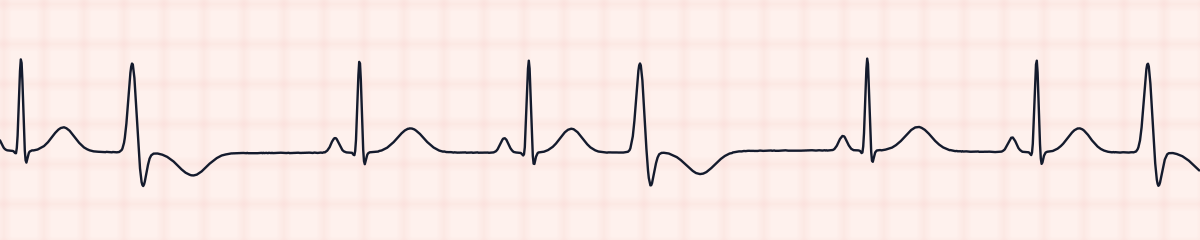
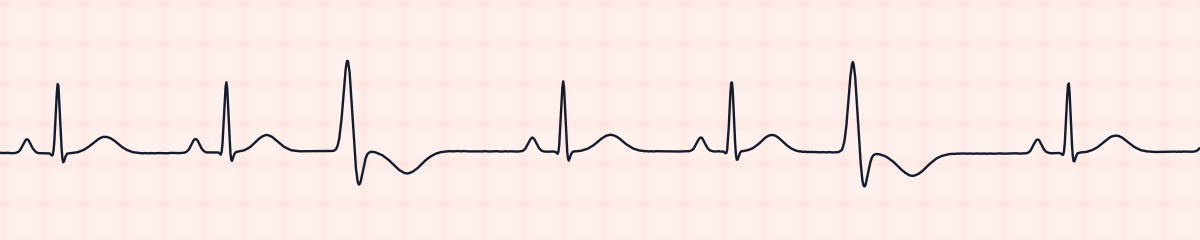
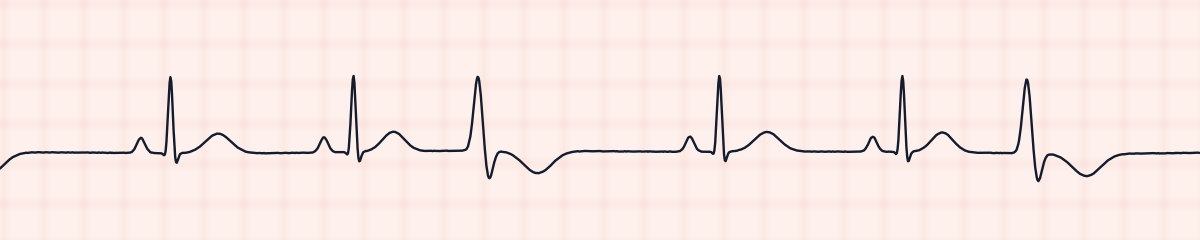
More ventricular trigeminy strips: no two are the same
A rhythm is a set of rules, not a picture. These three strips all meet the rules for ventricular trigeminy, with different numbers.
What ventricular trigeminy gets mistaken for
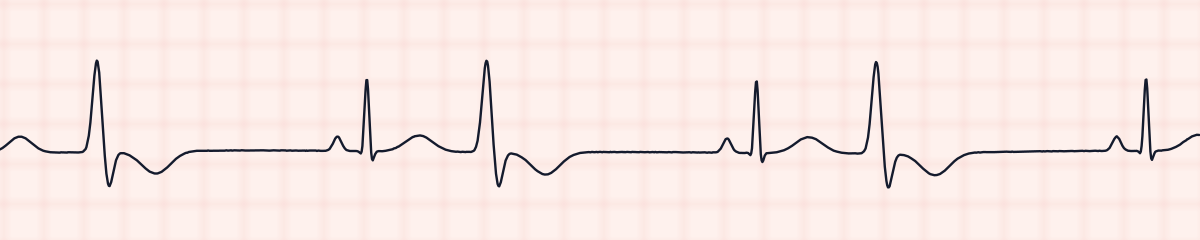
Ventricular trigeminy vs. ventricular bigeminy
Count the narrow beats between two PVCs. One narrow beat between them is bigeminy; two is trigeminy.
Ventricular trigeminy vs. premature ventricular contractions (PVCs)
Occasional PVCs have no fixed spacing, with three or more normal beats between them. Trigeminy keeps strict time: every third beat, all the way across.
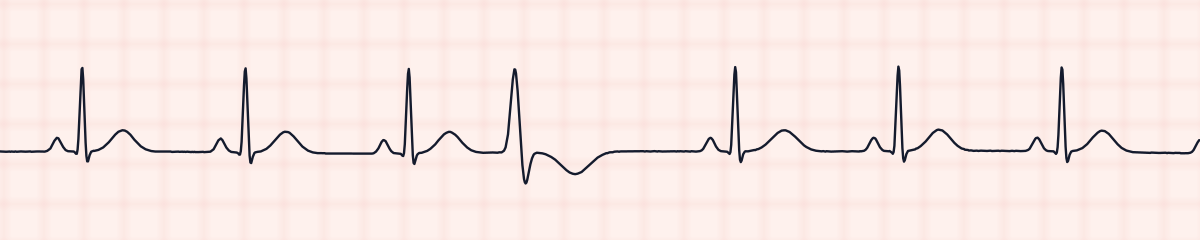
Ventricular trigeminy vs. second-degree AV block, type I (Wenckebach)
Wenckebach with 3:2 conduction also shows beats in small groups with pauses. All of its QRS complexes are narrow and each has a P wave, and its pause contains a P wave. In trigeminy the last beat of each group is wide and has no P wave.
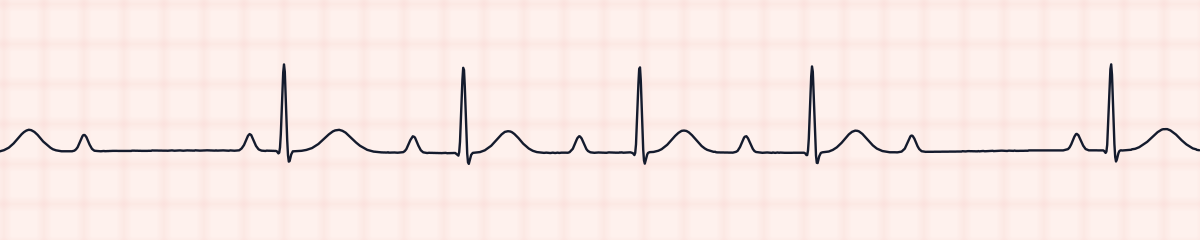
Practice: ventricular trigeminy or a look-alike?
Five strips. Some show ventricular trigeminy; the others are the rhythms most often confused with it.
Strip 1 of 5
Lead II · 25 mm/s · 6 s
Causes of ventricular trigeminy
- Low potassium or magnesium
- Reduced blood flow to the heart muscle
- Low oxygen levels
- Stimulants such as caffeine and decongestants
- Heart failure
- Digoxin toxicity
Why it matters
One beat in three is a PVC, which counts as frequent ventricular ectopy. Each PVC may be too weak to feel at the wrist, so the pulse can be about two thirds of the rate on the monitor. Sustained trigeminy tells you the ventricle is irritable and that something is provoking it.
What is done for ventricular trigeminy
- Feel a pulse for a full minute and compare it with the monitor.
- Assess for dizziness, chest discomfort or low blood pressure.
- Look at recent potassium and magnesium results and the oxygen saturation.
- Report trigeminy that is new, with a strip.
- Expect the cause to be treated; the pattern usually settles when it is.
Study summary, not a protocol. Follow current American Heart Association guidelines and your facility’s policies. See the medical disclaimer.
Common mistakes with ventricular trigeminy
- Miscounting the group and calling it bigeminy.
- Reporting the monitor’s number as the heart rate without confirming how many beats produce a pulse.
- Reading the grouped beats as a second-degree block without looking at the QRS width.
Questions about ventricular trigeminy
What is ventricular trigeminy?
A repeating pattern in which every third heartbeat is a PVC: two normal beats, then one premature ventricular beat.
How do you tell trigeminy from bigeminy on a strip?
Count the normal beats that come before each PVC. If there are two, it is trigeminy and the beats run in threes. If there is only one, it is bigeminy and they run in pairs.
Is trigeminy dangerous?
It is often tolerated, but it means PVCs are frequent. It is reported when new, and the cause, commonly an electrolyte problem, low oxygen or ischemia, is looked for and treated.