Ventricular rhythms
PVC couplet EKG strip
A ventricular couplet is two premature ventricular contractions in a row. On an EKG strip a normal rhythm is interrupted by a pair of wide, bizarre beats with no P waves and no normal beat between them, followed by a pause before the normal rhythm returns. It is also called paired PVCs.
Criteria from the American Heart Association guidelines and published ECG standards · Every strip checked by measurement · Sources and method · Updated November 15, 2026
- Rate
- Underlying rhythm
- PR interval
- None on the PVCs
- QRS
- Two wide beats in a row
How to identify a PVC couplet in five steps
Ask the same five questions of every strip. The right-hand column is what each one finds on the strip above.
1Rate
That of the underlying rhythm; count all the complexes for the strip rate.
~70 bpm
2Rhythm
Regular, then two early beats close together, then a pause.
Regular, with two early beats in a row
3P waves
Normal on the sinus beats; none in front of either PVC.
None on the early beats
4PR interval
Normal on the sinus beats.
0.17 s on sinus beats
5QRS
Narrow on the sinus beats; both beats of the pair are 0.12 s or wider.
0.07 s; early beats 0.17 s
What is happening in the heart
A focus in the ventricle fires twice in quick succession before the SA node regains control. Each impulse spreads slowly through the ventricular muscle, so each complex is wide. Firing twice instead of once shows that the focus is more irritable, or that a small circuit in the ventricle has completed two laps.
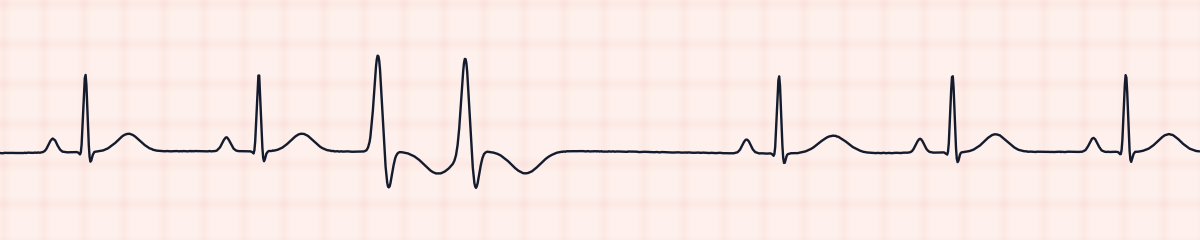
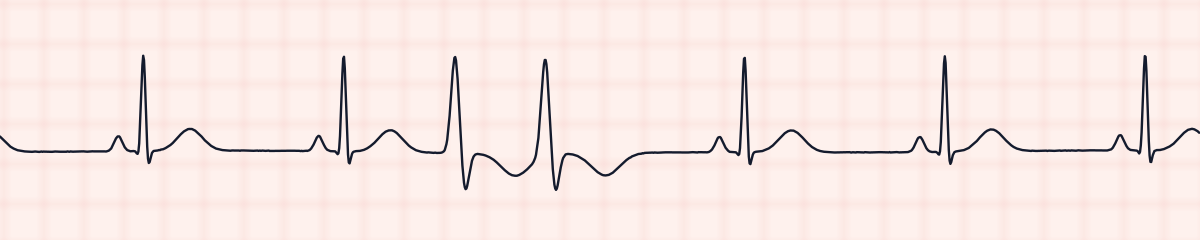
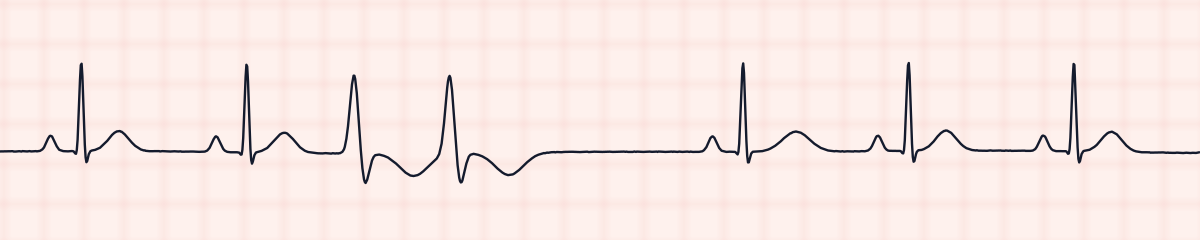
More PVC couplet strips: no two are the same
A rhythm is a set of rules, not a picture. These three strips all meet the rules for a PVC couplet, with different numbers.
What a PVC couplet gets mistaken for
PVC couplet vs. premature ventricular contractions (PVCs)
A single PVC stands alone between normal beats. In a couplet the second wide beat follows the first directly.
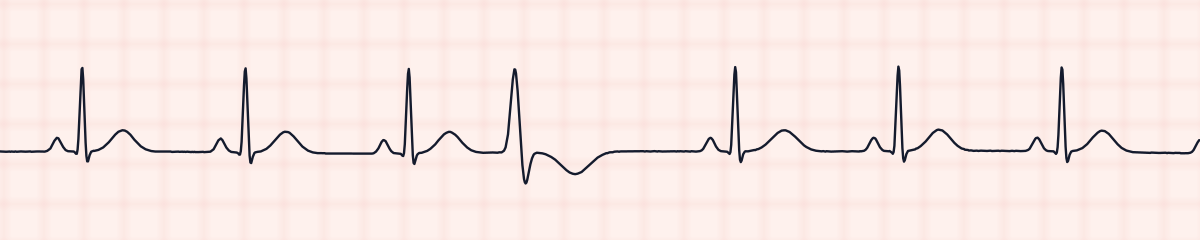
PVC couplet vs. ventricular triplet (three PVCs in a row)
Count the wide beats in the run. Two is a couplet. Three is a triplet, which already meets the definition of ventricular tachycardia.
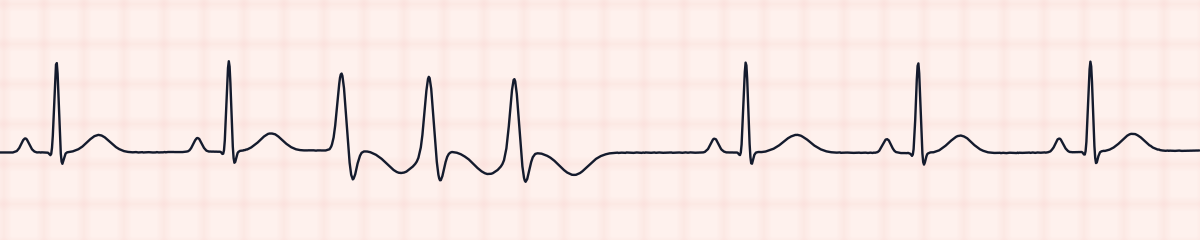
PVC couplet vs. ventricular bigeminy
Bigeminy also has many wide beats, but each one is separated from the next by a normal beat. In a couplet the two wide beats touch.
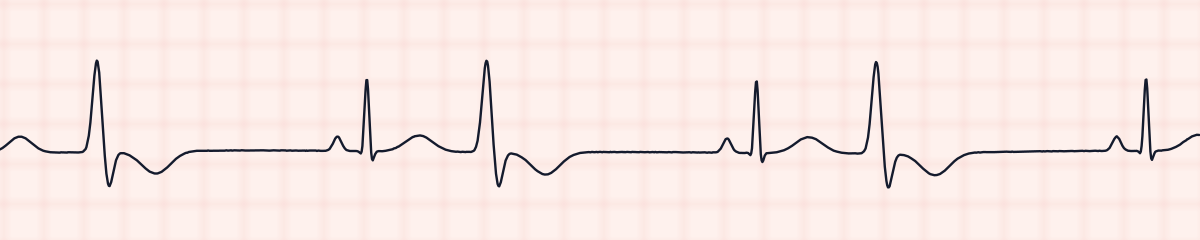
Practice: a PVC couplet or a look-alike?
Five strips. Some show a PVC couplet; the others are the rhythms most often confused with it.
Strip 1 of 5
Lead II · 25 mm/s · 6 s
Causes of a PVC couplet
- Myocardial ischemia or infarction
- Low potassium or low magnesium
- Hypoxia
- Cardiomyopathy and heart failure
- Medication that lengthens the QT interval
- Stimulants
Why it matters
A couplet is one step along the road from isolated PVCs to ventricular tachycardia. On its own it rarely causes symptoms, but it shows that the ventricle can sustain more than one abnormal beat, and couplets that become frequent often precede longer runs.
What is done for a PVC couplet
- Assess the patient and vital signs.
- Print and save the strip; note how often pairs occur.
- Review potassium, magnesium and oxygen saturation.
- Notify the provider of new couplets, particularly after a heart attack or with a long QT.
- Watch for longer runs.
Study summary, not a protocol. Follow current American Heart Association guidelines and your facility’s policies. See the medical disclaimer.
Common mistakes with a PVC couplet
- Counting a couplet as two separate PVCs and under-reporting it.
- Missing the second beat because it is partly buried in the T wave of the first.
- Calling a pair a run of ventricular tachycardia; that term starts at three.
Questions about a PVC couplet
What is a PVC couplet?
Two PVCs one after the other, with no normal beat between them.
Are PVC couplets dangerous?
A single couplet in a healthy person is usually benign. Couplets are taken more seriously than single PVCs because they show a more irritable ventricle, and they are reported when new, frequent, or seen with heart disease.
What is the difference between a couplet and a triplet?
A couplet is two PVCs in a row. A triplet is three in a row, and three consecutive ventricular beats at a rate over 100 is classed as a short run of ventricular tachycardia.