Sinus rhythms
Sinus tachycardia EKG strip
Sinus tachycardia is a sinus rhythm faster than 100 beats per minute. On an EKG strip it is regular, with an upright P wave before every QRS, a normal PR interval and a narrow QRS. At rest it rarely exceeds about 150. It is the body’s response to a demand, not a fault in the heart’s wiring.
Criteria from the American Heart Association guidelines and published ECG standards · Every strip checked by measurement · Sources and method · Updated November 15, 2026
- Rate
- 101–150
- PR interval
- 0.12–0.20 s
- QRS
- < 0.12 s
How to identify sinus tachycardia in five steps
Ask the same five questions of every strip. The right-hand column is what each one finds on the strip above.
1Rate
101 to about 150 at rest. It rises and falls gradually with whatever is driving it.
123 bpm
2Rhythm
Regular.
Regular
3P waves
Present and upright before every QRS. At faster rates look for it on the downslope of the preceding T wave.
1 per QRS
4PR interval
0.12 to 0.20 s, usually toward the short end, and constant.
0.15 s
5QRS
Narrower than 0.12 s.
0.08 s
What is happening in the heart
The SA node speeds up because something is telling it to: the sympathetic nervous system, circulating adrenaline, fever, or a fall in blood volume or oxygen. The impulse takes the normal pathway, so the P wave, PR interval and QRS all keep their normal shape. As the rate climbs, the gap between beats shortens and the P wave moves closer to the T wave in front of it.
More sinus tachycardia strips: no two are the same
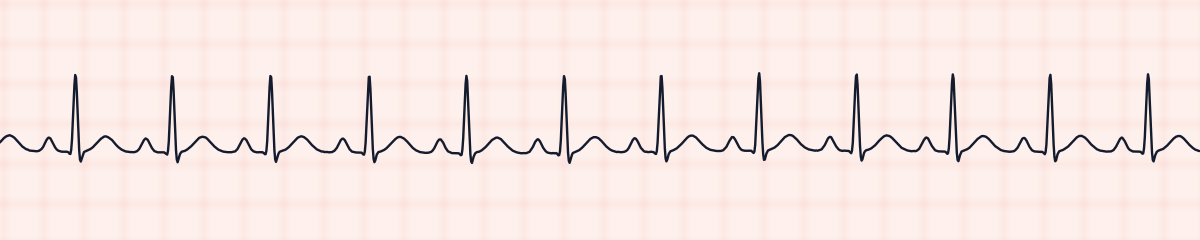
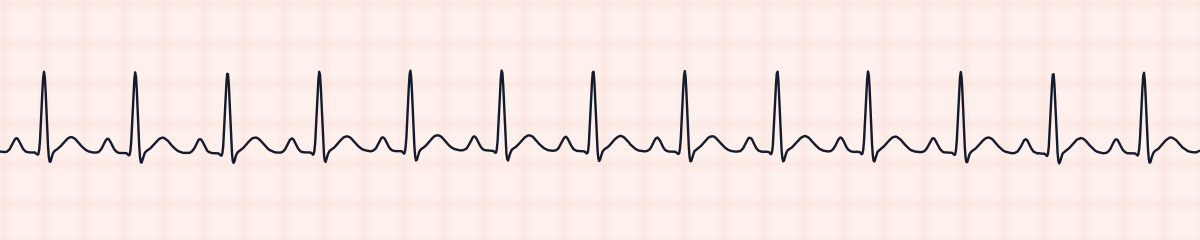
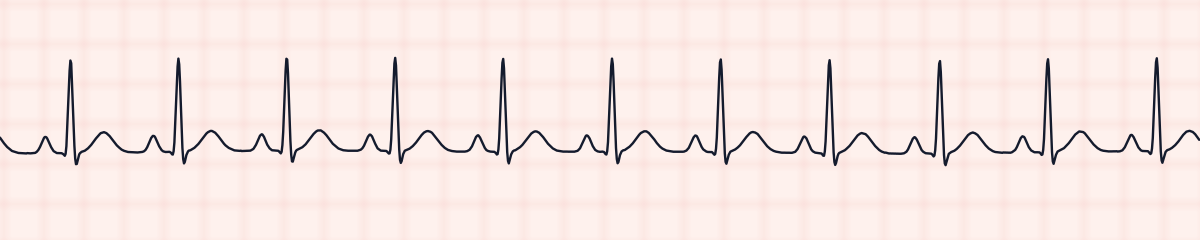
A rhythm is a set of rules, not a picture. These three strips all meet the rules for sinus tachycardia, with different numbers.
What sinus tachycardia gets mistaken for
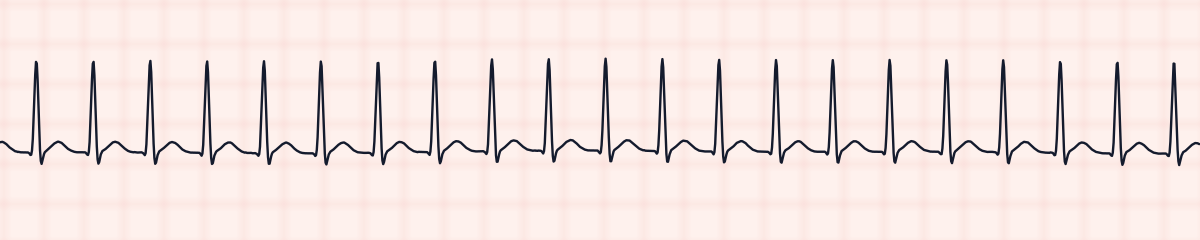
Sinus tachycardia vs. supraventricular tachycardia (SVT)
SVT is usually faster than 150, has no P waves you can find, and begins and ends in a single beat. Sinus tachycardia has P waves, changes rate gradually, and the patient usually has an obvious reason for it.
Sinus tachycardia vs. atrial flutter
Flutter with 2:1 conduction gives a regular narrow rhythm near 150 and is easily mistaken for sinus tachycardia. Look at the baseline between complexes: a sawtooth with no flat stretch is flutter.
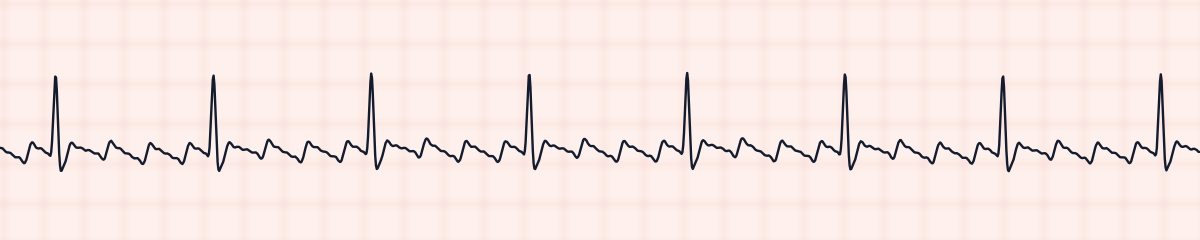
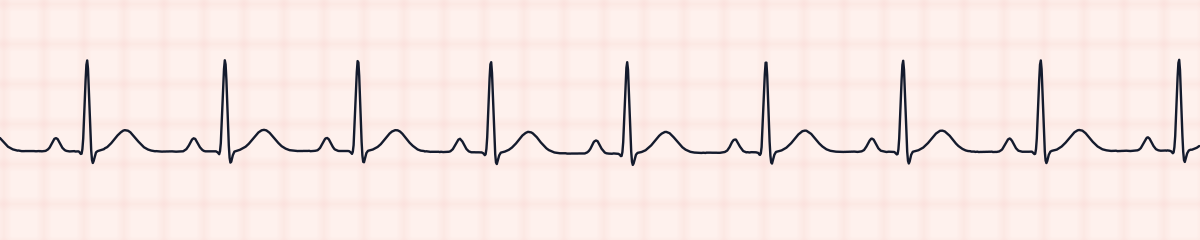
Sinus tachycardia vs. normal sinus rhythm
Identical apart from the rate. Count it: over 100 is tachycardia.
Practice: sinus tachycardia or a look-alike?
Five strips. Some show sinus tachycardia; the others are the rhythms most often confused with it.
Strip 1 of 5
Lead II · 25 mm/s · 6 s
Causes of sinus tachycardia
- Fever and infection, including sepsis
- Pain, anxiety and exertion
- Blood loss, dehydration and other causes of low blood volume
- Hypoxia and anemia
- Pulmonary embolism
- Heart failure, as the heart tries to maintain output
- Hyperthyroidism
- Caffeine, nicotine, decongestants and other stimulants
Why it matters
Sinus tachycardia is a sign. It tells you the body is compensating for something, and it is often the earliest warning of bleeding, sepsis or respiratory trouble, before the blood pressure falls. It also raises the heart’s oxygen demand while shortening the time the coronary arteries have to fill, which matters in a patient with heart disease.
What is done for sinus tachycardia
- Ask why. Look for fever, pain, bleeding, low oxygen saturation, low urine output, new medications.
- Treat the cause: fluids, oxygen, pain relief, antipyretics, as ordered.
- Do not treat the rate as the problem. Slowing a compensating heart can make the patient worse.
- Vagal maneuvers, adenosine and cardioversion are for SVT, not for sinus tachycardia.
- Report a new or unexplained resting tachycardia, and trend it with the other vital signs.
Study summary, not a protocol. Follow current American Heart Association guidelines and your facility’s policies. See the medical disclaimer.
Common mistakes with sinus tachycardia
- Calling it SVT because it is fast, without looking for P waves.
- Missing P waves that sit on top of the T wave. Compare T waves: one with an extra hump is hiding a P.
- Documenting the rhythm and moving on. A resting rate of 120 needs an explanation.
Questions about sinus tachycardia
What is the rate of sinus tachycardia?
More than 100 beats per minute, usually up to about 150 at rest. During exercise a healthy sinus rate can go higher; a rough maximum is 220 minus the person’s age.
How do you treat sinus tachycardia?
By treating whatever is causing it: fluids for dehydration or bleeding, oxygen for hypoxia, pain relief, treatment of fever or infection. The fast rate itself is usually left alone.
Can you see P waves in sinus tachycardia?
Yes. There is a P wave before every QRS. As the rate increases the P wave moves closer to the previous T wave and may merge with it, but it is still there.