Paced rhythms
Pacemaker Failure to Sense on an EKG Strip
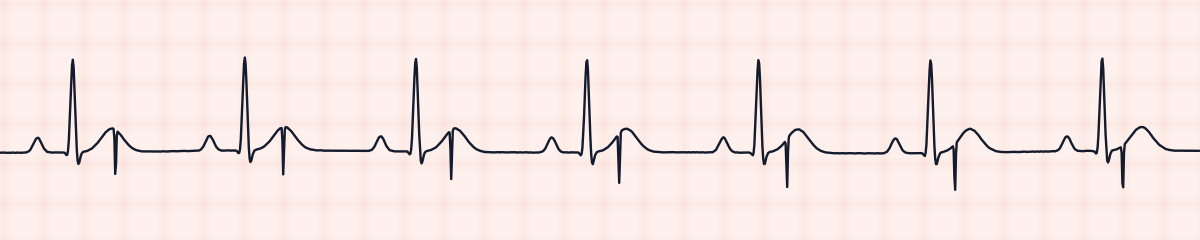
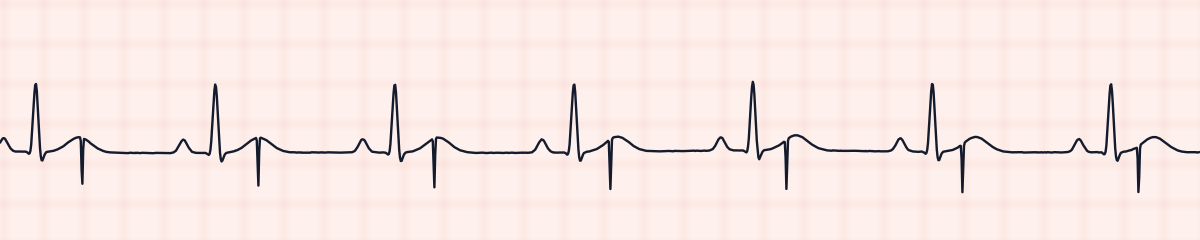
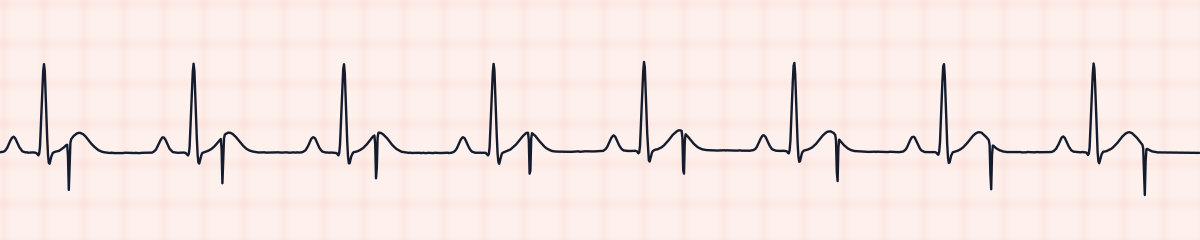
Failure to sense, also called undersensing, is a pacemaker malfunction in which the device does not detect the heart’s own beats. It paces as if nothing were there, so pacing spikes turn up where they are not needed: just after a normal QRS, in the ST segment, or on the T wave.
Criteria from the American Heart Association guidelines and published ECG standards · Every strip checked by measurement · Sources and method · Updated November 15, 2026
- Rate
- The patient's own rate
- PR interval
- Normal on the patient's own beats
- QRS
- < 0.12 s
How to identify failure to sense in five steps
Ask the same five questions of every strip. The right-hand column is what each one finds on the strip above.
1Rate
The patient’s own rate, plus any extra paced beats.
72 bpm
2Rhythm
The underlying rhythm keeps its own timing and the spikes keep theirs; the two do not line up.
Regular
3P waves
Whatever the underlying rhythm has: in sinus rhythm, one ahead of each natural QRS.
1 per QRS
4PR interval
Normal on the beats the heart makes for itself.
0.17 s
5QRS
Narrow on the patient’s own beats. Spikes fall after them, not in front of them.
0.09 s; a pacing spike after each
What is happening in the heart
A demand pacemaker listens before it fires. When it detects a natural beat it resets its timer and stays quiet; it paces only if no beat arrives in time. If the natural signal reaching the lead is too small, or the device is set to be too hard of hearing, the beat goes unnoticed and the timer runs out as though the heart had paused. The pacemaker then fires at its own fixed interval, out of step with the patient’s rhythm. A spike that lands while the ventricle is still recovering from the previous beat produces nothing; one that lands later may capture and add an extra, wide beat.
More failure to sense strips: no two are the same
A rhythm is a set of rules, not a picture. These three strips all meet the rules for failure to sense, with different numbers.
What failure to sense gets mistaken for
Failure to sense vs. pacemaker failure to capture
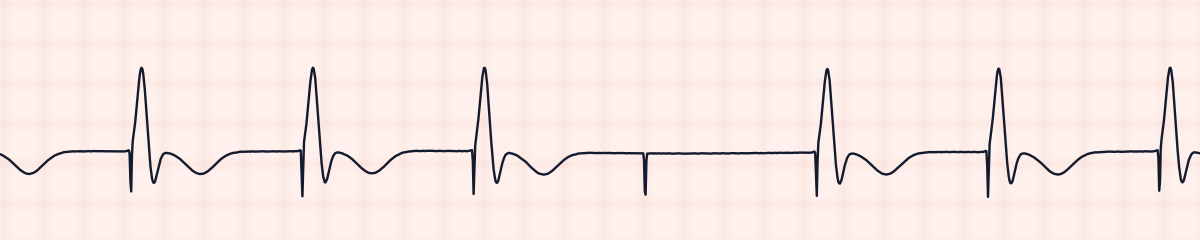
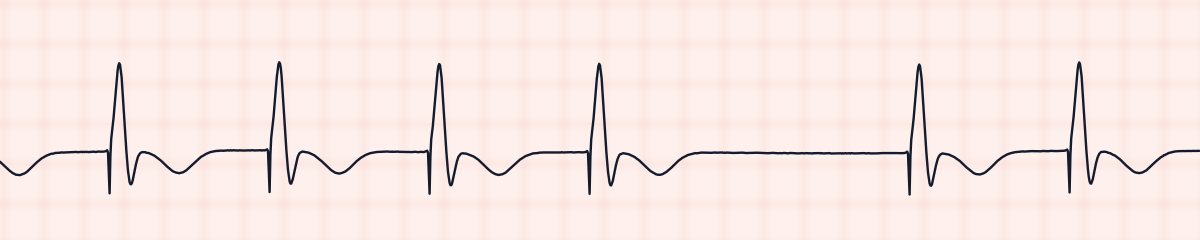
Both show spikes with no QRS behind them. In failure to capture the spike is on time and the beat it should have caused is missing, which leaves a pause. In failure to sense there is no pause: the heart is beating by itself and the spike is simply unwanted.
Failure to sense vs. pacemaker failure to pace (failure to fire)
Failure to pace is the opposite picture, a gap with no spike in it. Here there are too many spikes, not too few.
Failure to sense vs. atrial paced rhythm
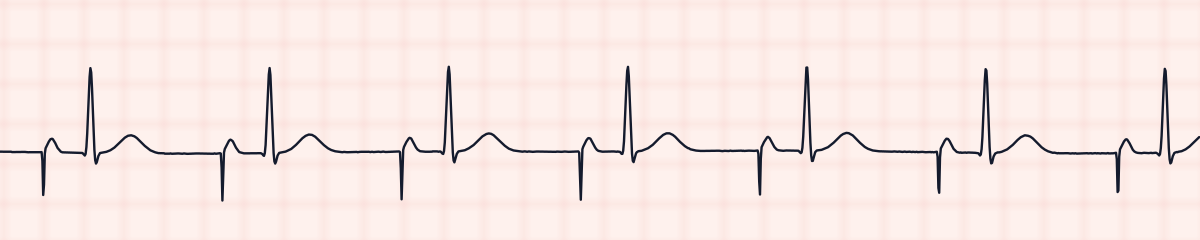
In atrial pacing a spike stands directly in front of each P wave and belongs to that beat. An undersensing spike trails the QRS and belongs to nothing.
Practice: failure to sense or a look-alike?
Five strips. Some show failure to sense; the others are the rhythms most often confused with it.
Strip 1 of 5
Lead II · 25 mm/s · 6 s
Causes of failure to sense
- A lead that has moved, fractured or lost its insulation
- Sensitivity programmed too low (on a temporary pacemaker, the millivolt number set too high)
- A natural signal that has shrunk: after a heart attack, with scarring, or with electrolyte changes
- A low battery
- Asynchronous mode chosen on purpose, with a magnet over the device or during some procedures, which looks the same
Why it matters
A pacing spike delivered on the T wave strikes the ventricle at its most electrically unstable moment. Most such spikes do nothing, but one can set off ventricular tachycardia or fibrillation; this is the R-on-T phenomenon. Extra paced beats can also make the pulse irregular. For these reasons undersensing is corrected promptly even when the patient feels well.
What is done for failure to sense
- Check the patient: pulse, blood pressure, symptoms.
- Save a strip that shows where the spikes fall, and notify the provider.
- For a temporary pacemaker, check the connections and expect the sensitivity to be adjusted so that the device can see smaller signals.
- Keep the patient on the monitor and be prepared for a ventricular arrhythmia.
- A permanent device is interrogated and reprogrammed by the pacemaker team.
Study summary, not a protocol. Follow current American Heart Association guidelines and your facility’s policies. See the medical disclaimer.
Common mistakes with failure to sense
- Looking only at whether each spike captures, and not at whether it should have fired at all.
- Labelling the spikes failure to capture because no QRS follows them.
- Missing small spikes buried in the T wave. Compare each T wave with its neighbours.
- Turning the sensitivity dial the wrong way on a temporary pacemaker: a lower millivolt value makes the device more sensitive.
Questions about failure to sense
What does failure to sense look like on an EKG?
Pacing spikes at times when the heart has just beaten by itself: after a natural QRS, in the ST segment or on the T wave. The spikes follow the pacemaker’s clock and ignore the patient’s rhythm.
Why is failure to sense dangerous?
Because a spike can fall on the T wave, during the vulnerable part of repolarization, and trigger ventricular tachycardia or ventricular fibrillation.
What is the difference between undersensing and oversensing?
With undersensing the pacemaker misses real beats and paces when it should not. With oversensing it mistakes other signals, such as muscle activity, for beats and holds back when it should pace, which shows up as pauses.
How is undersensing corrected on a temporary pacemaker?
Once the patient, the cables and the battery have been checked, the sensitivity is increased by lowering the millivolt setting, following the provider’s order and unit policy.