AV blocks
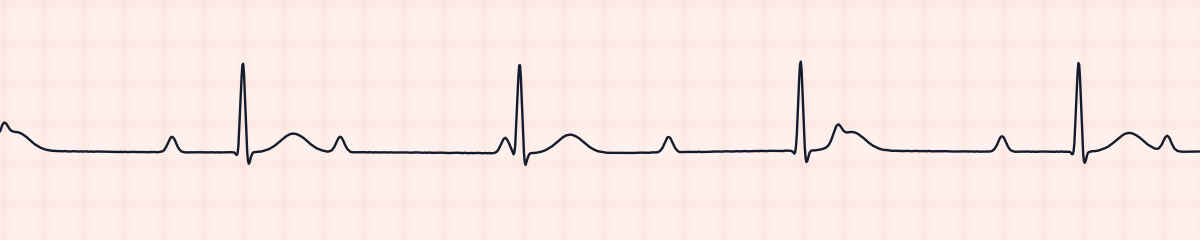
Second-degree heart block type 2 (Mobitz II) EKG strip
Second-degree AV block type II, or Mobitz II, is a rhythm in which some P waves are suddenly not followed by a QRS, while the PR interval of the conducted beats stays exactly the same. There is no lengthening before the dropped beat and no shortening after it. The QRS is often wide.
Criteria from the American Heart Association guidelines and published ECG standards · Every strip checked by measurement · Sources and method · Updated November 15, 2026
- Rate
- Atrial > ventricular
- PR interval
- Constant, then a drop
- QRS
- Often wide
How to identify Mobitz II in five steps
Ask the same five questions of every strip. The right-hand column is what each one finds on the strip above.
1Rate
The atrial rate is regular and faster than the ventricular rate. The ventricular rate is often slow.
~60 bpm
2Rhythm
Irregular where a beat is dropped. The pause is as long as two normal cycles.
Irregular
3P waves
Normal and on time, marching through the pause. More P waves than QRS complexes.
More Ps than QRSs
4PR interval
Constant on every conducted beat, before and after the dropped beat. It may be normal or long.
0.17 s, constant
5QRS
Often 0.12 s or wider, because the block lies in the bundle branches. It can be narrow.
0.14 s
What is happening in the heart
The problem is below the AV node, in the bundle of His or the bundle branches. That tissue conducts all or nothing: an impulse either crosses at normal speed or does not cross at all. So the PR interval does not stretch as a warning. Disease in the bundle branches also explains why the QRS is frequently wide.
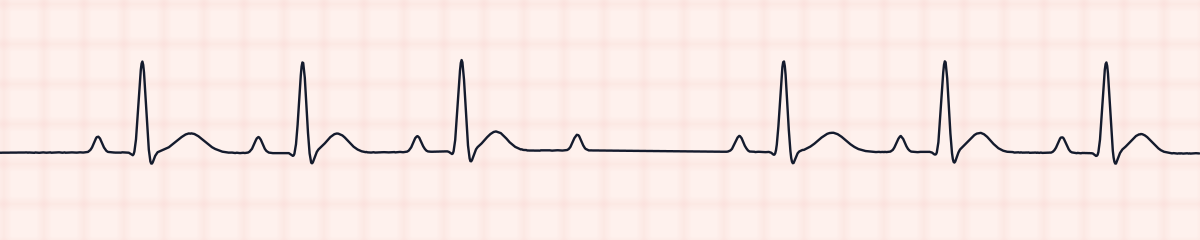
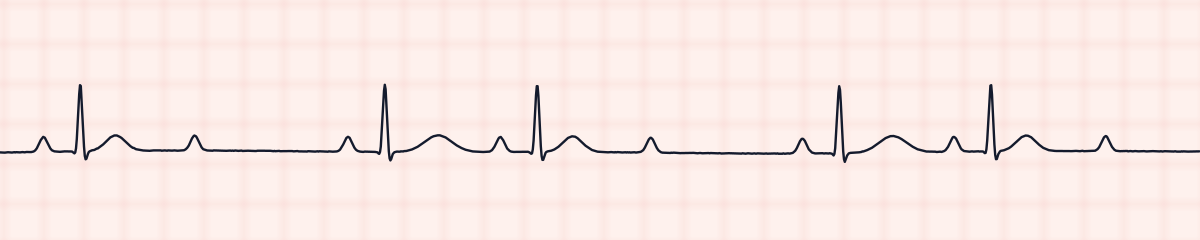
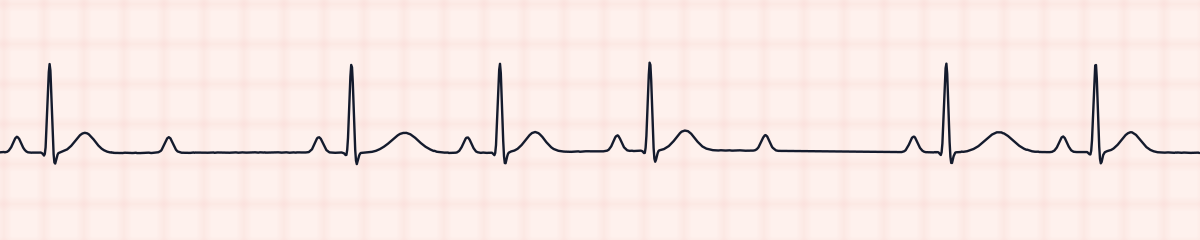
More Mobitz II strips: no two are the same
A rhythm is a set of rules, not a picture. These three strips all meet the rules for Mobitz II, with different numbers.
What Mobitz II gets mistaken for
Mobitz II vs. second-degree AV block, type I (Wenckebach)
Measure the PR interval on each side of the dropped beat. If they match, it is Mobitz II. If the one before the drop is longer than the one after, it is Wenckebach.
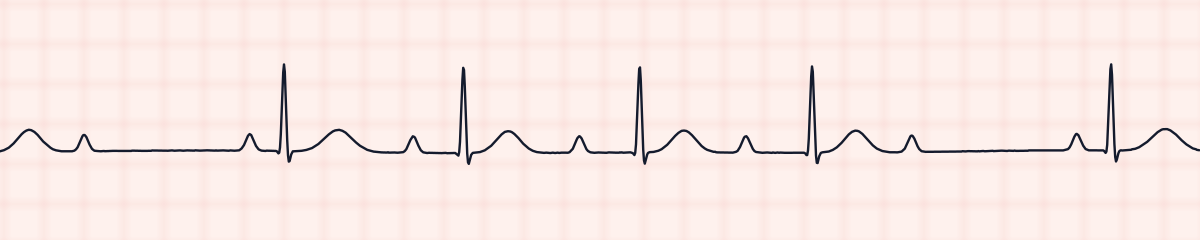
Mobitz II vs. third-degree (complete) AV block
In Mobitz II the conducted beats have a fixed PR interval, so the P waves and QRS complexes are related. In complete heart block no PR interval repeats and the ventricular rhythm is regular.
Practice: Mobitz II or a look-alike?
Five strips. Some show Mobitz II; the others are the rhythms most often confused with it.
Strip 1 of 5
Lead II · 25 mm/s · 6 s
Causes of Mobitz II
- Anterior myocardial infarction
- Scarring or degeneration of the conduction system with age
- After cardiac surgery or valve procedures
- Myocarditis and infiltrative heart disease
Why it matters
Mobitz II is unstable. It can turn into complete heart block without warning, and the backup rhythm that takes over is slow and unreliable. This is why a learner is expected to separate it from Wenckebach every time: the two look alike, but this one usually ends with a pacemaker.
What is done for Mobitz II
- Notify the provider promptly, even if the patient feels well.
- Keep the patient monitored and have transcutaneous pacing equipment ready.
- Atropine often does not work, because the block is below the AV node where the drug acts.
- For a symptomatic slow rate, pacing is the treatment; dopamine or epinephrine infusions are used as a bridge.
- Most patients go on to a permanent pacemaker.
Study summary, not a protocol. Follow current American Heart Association guidelines and your facility’s policies. See the medical disclaimer.
Common mistakes with Mobitz II
- Deciding from the dropped beat alone. Both second-degree blocks drop beats; only the PR intervals tell them apart.
- Assuming a narrow QRS rules it out. A wide QRS is common in Mobitz II but is not required.
- Naming 2:1 block as type II. With only one conducted beat between drops there is nothing to compare, so the strip cannot show which type it is.
Questions about Mobitz II
What is the difference between Mobitz I and Mobitz II?
In Mobitz I (Wenckebach) the PR interval lengthens before a beat is dropped. In Mobitz II the PR interval does not change and the beat is dropped suddenly. Mobitz I is in the AV node and is usually benign; Mobitz II is below it and can progress to complete block.
Why does atropine not work well in Mobitz II?
Atropine speeds conduction through the AV node. In Mobitz II the block is lower, in the His-Purkinje system, so speeding the node does not help and can even increase the number of blocked beats.
Does Mobitz II need a pacemaker?
Usually, yes. Because it can progress suddenly to complete heart block, a permanent pacemaker is generally recommended, even for patients without symptoms.