Sinus rhythms
Sinus arrhythmia EKG strip
Sinus arrhythmia is a sinus rhythm whose rate rises and falls in a cycle, usually with breathing. On an EKG strip every beat is a normal sinus beat, with an upright P wave, a constant PR interval and a narrow QRS, but the R-R intervals gradually lengthen and shorten. The longest and shortest differ by more than 0.12 to 0.16 seconds.
Criteria from the American Heart Association guidelines and published ECG standards · Every strip checked by measurement · Sources and method · Updated November 15, 2026
- Rate
- 60–100, varying
- PR interval
- 0.12–0.20 s
- QRS
- < 0.12 s
How to identify sinus arrhythmia in five steps
Ask the same five questions of every strip. The right-hand column is what each one finds on the strip above.
1Rate
Usually 60 to 100 on average. Because it is irregular, count the QRS complexes in 6 seconds and multiply by 10.
~60 bpm
2Rhythm
Irregular, but smoothly so: the intervals drift longer, then shorter, in step with respiration.
Irregular, gradual
3P waves
Upright, uniform, one before every QRS.
1 per QRS
4PR interval
0.12 to 0.20 s and the same on every beat.
0.18 s
5QRS
Narrower than 0.12 s.
0.09 s
What is happening in the heart
Breathing changes the tone of the vagus nerve. Breathing in reduces vagal tone and the SA node speeds up; breathing out restores it and the node slows down. The pacemaker and the conduction pathway are normal throughout, so only the spacing between beats changes. The effect is strongest in children and young adults and fades with age.
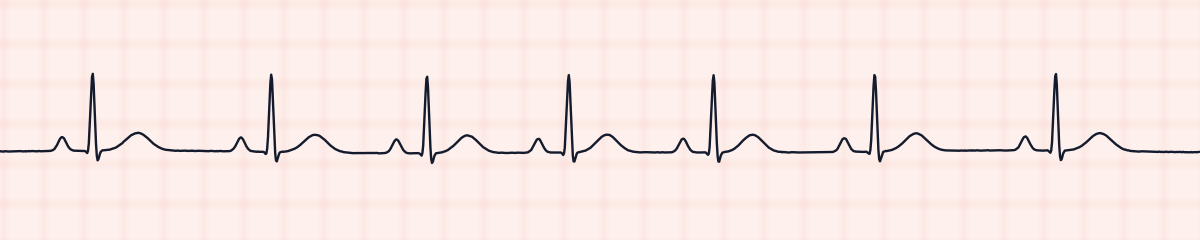
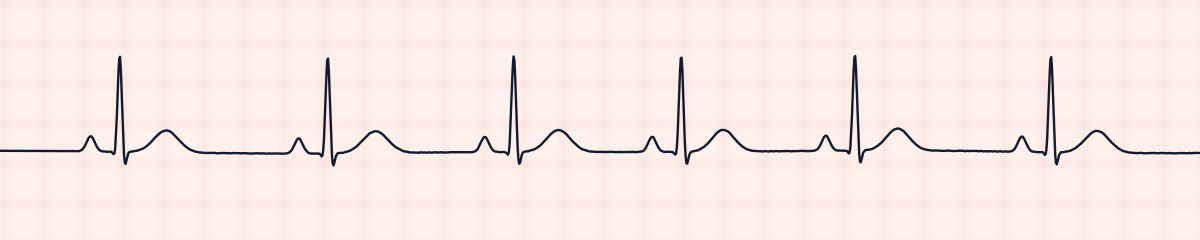
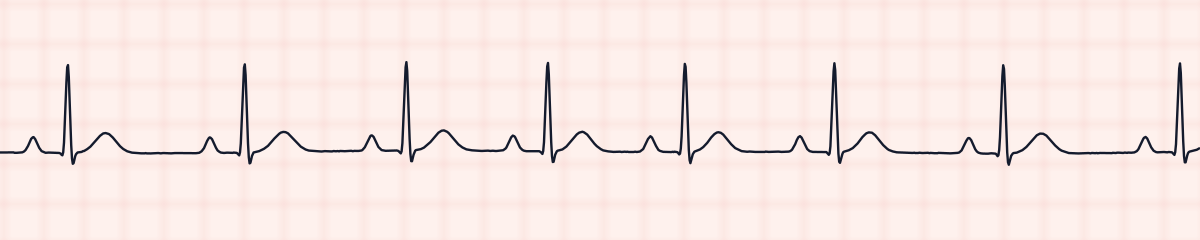
More sinus arrhythmia strips: no two are the same
A rhythm is a set of rules, not a picture. These three strips all meet the rules for sinus arrhythmia, with different numbers.
What sinus arrhythmia gets mistaken for
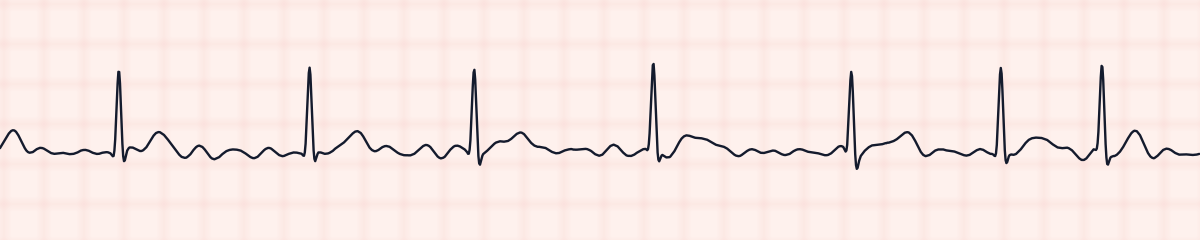
Sinus arrhythmia vs. atrial fibrillation
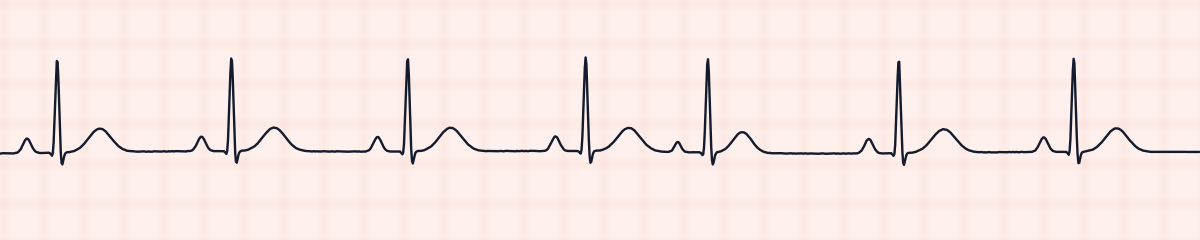
Both are irregular with a narrow QRS. Atrial fibrillation has no P waves and its intervals change at random. Sinus arrhythmia has a clear P wave before every QRS and its intervals change in a smooth wave.
Sinus arrhythmia vs. premature atrial contractions (PACs)
A premature atrial beat arrives suddenly early and its P wave looks different from the rest. In sinus arrhythmia no single beat is early; the whole rhythm eases faster and slower, and every P wave is the same shape.
Sinus arrhythmia vs. sinus arrest (sinus pause)
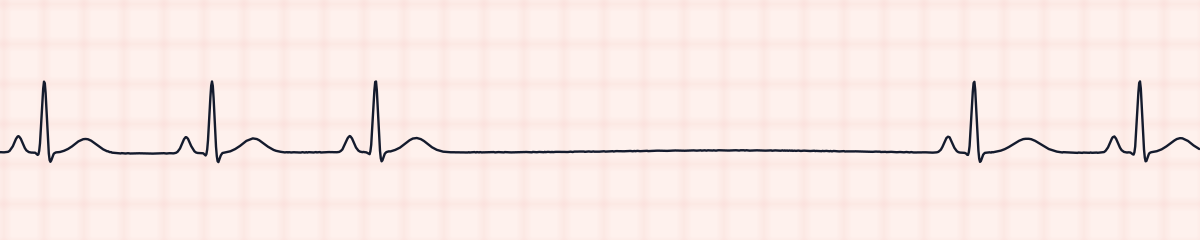
A sinus pause is one long gap, at least twice the usual interval, in an otherwise regular rhythm. Sinus arrhythmia has no gap that stands out; its longest interval is only a little longer than its neighbors.
Practice: sinus arrhythmia or a look-alike?
Five strips. Some show sinus arrhythmia; the others are the rhythms most often confused with it.
Strip 1 of 5
Lead II · 25 mm/s · 6 s
Causes of sinus arrhythmia
- Normal breathing, especially in children, teenagers and young adults
- Athletic conditioning and high resting vagal tone
- Sleep
- Less commonly, digoxin or raised pressure inside the skull, where the variation is not tied to breathing
Why it matters
It is a normal finding and usually a sign of a healthy, responsive nervous system. Its importance is in not mistaking it for something else. An irregular strip makes people think of atrial fibrillation, and treating a healthy young patient for that would be an error. The P waves settle it.
What is done for sinus arrhythmia
- No treatment.
- Confirm the pattern by watching the patient breathe while the monitor runs: the rate follows the breaths.
- Document it as sinus arrhythmia with the rate range.
- If the irregularity is new in an older patient or unrelated to breathing, report it and review the medications.
Study summary, not a protocol. Follow current American Heart Association guidelines and your facility’s policies. See the medical disclaimer.
Common mistakes with sinus arrhythmia
- Calling it atrial fibrillation without checking for P waves.
- Calling it normal sinus rhythm. The beats are sinus, but the rhythm is not regular and should be named accurately.
- Working out the rate from one R-R interval, which gives a different answer depending on which one you pick.
Questions about sinus arrhythmia
Is sinus arrhythmia normal?
Yes. Respiratory sinus arrhythmia is a normal variation, most noticeable in children and young adults. It needs no treatment.
What is the difference between sinus arrhythmia and sinus rhythm?
In both, every beat starts in the SA node. In sinus rhythm the beats are evenly spaced. In sinus arrhythmia the spacing varies, with the longest and shortest R-R intervals more than about 0.12 to 0.16 seconds apart.
How do you tell sinus arrhythmia from AFib?
Look for P waves. Sinus arrhythmia has one upright P wave before every QRS with a fixed PR interval. Atrial fibrillation has no P waves at all, only a wavy baseline.