Junctional rhythms
Accelerated junctional rhythm EKG strip
Accelerated junctional rhythm is a rhythm from the AV junction at 60 to 100 beats per minute, faster than the junction’s natural rate. On an EKG strip it is regular with a narrow QRS, and the P wave is absent or inverted. It looks like normal sinus rhythm with the P waves taken away.
Criteria from the American Heart Association guidelines and published ECG standards · Every strip checked by measurement · Sources and method · Updated November 15, 2026
- Rate
- 60–100
- PR interval
- None, or under 0.12 s
- QRS
- < 0.12 s
How to identify accelerated junctional rhythm in five steps
Ask the same five questions of every strip. The right-hand column is what each one finds on the strip above.
1Rate
60 to 100.
83 bpm
2Rhythm
Regular.
Regular
3P waves
Absent, or inverted in lead II immediately before or after the QRS.
Inverted, before each QRS
4PR interval
None, or shorter than 0.12 s.
0.11 s, short
5QRS
Narrower than 0.12 s.
0.08 s
What is happening in the heart
Here the junction is not stepping in as a backup. Its pacemaker cells have become irritable and are firing faster than they should, fast enough to outrun the SA node and take control of the heart. This is called enhanced automaticity. The impulse still reaches the ventricles by the normal route, so the QRS remains narrow.
More accelerated junctional rhythm strips: no two are the same
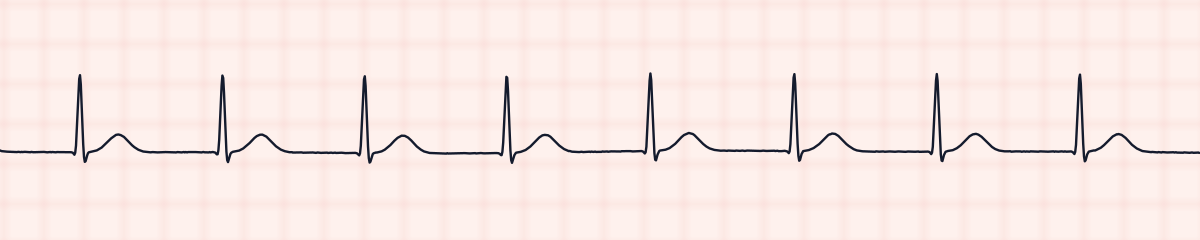
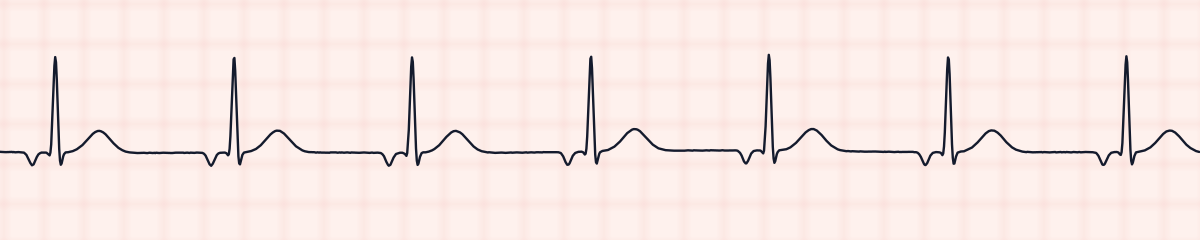
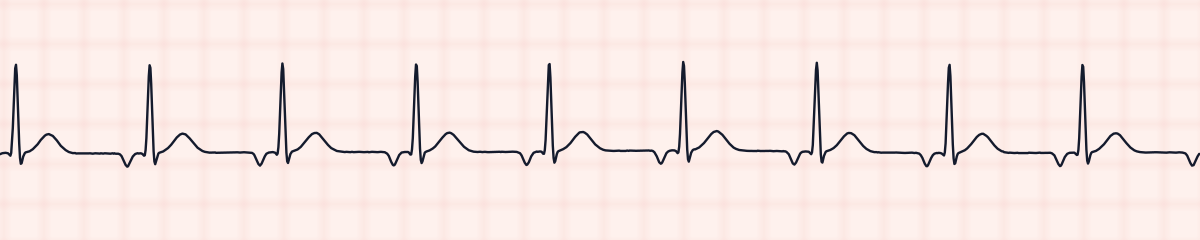
A rhythm is a set of rules, not a picture. These three strips all meet the rules for accelerated junctional rhythm, with different numbers.
What accelerated junctional rhythm gets mistaken for
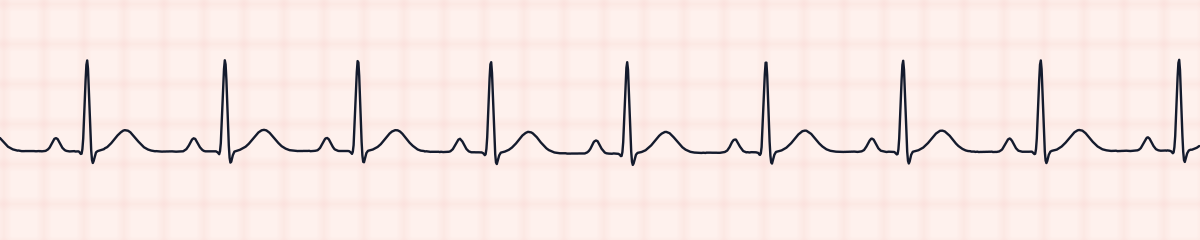
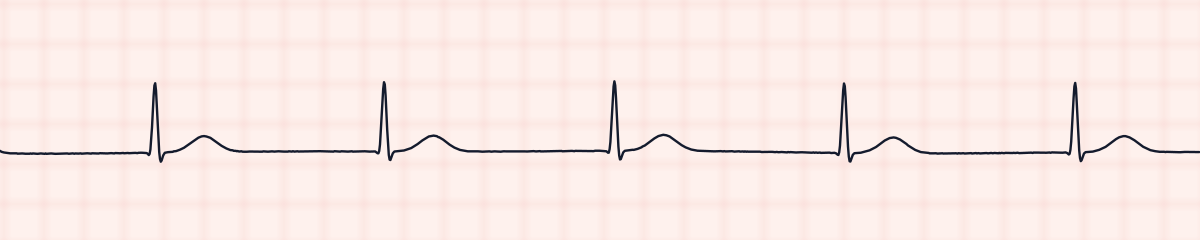
Accelerated junctional rhythm vs. normal sinus rhythm
The rate, the regularity and the QRS are the same as in normal sinus rhythm. The difference is entirely in front of the QRS: a normal upright P wave with a PR of at least 0.12 s means sinus; no such P wave means junctional.
Accelerated junctional rhythm vs. junctional rhythm
A junctional escape rhythm is the same pattern at 40 to 60. The rate tells you whether the junction is rescuing the heart or has taken it over.
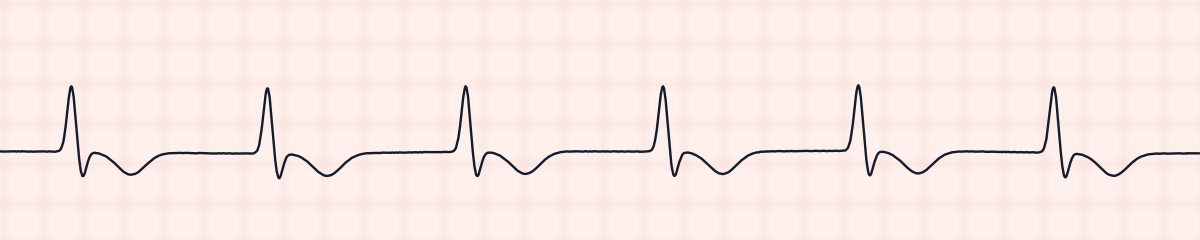
Accelerated junctional rhythm vs. accelerated idioventricular rhythm (AIVR)
Accelerated idioventricular rhythm occupies a similar range of rates and also lacks P waves, but its QRS is wide. Measure the width.
Practice: accelerated junctional rhythm or a look-alike?
Five strips. Some show accelerated junctional rhythm; the others are the rhythms most often confused with it.
Strip 1 of 5
Lead II · 25 mm/s · 6 s
Causes of accelerated junctional rhythm
- Digoxin toxicity, the classic cause
- Recent cardiac surgery, particularly valve surgery
- Inferior myocardial infarction
- Myocarditis and rheumatic fever
- Low potassium
- Chronic lung disease with hypoxia
Why it matters
The rate is normal, so most patients tolerate it, and the rhythm itself is rarely the danger. Its value is as a clue. An irritable junction in a patient taking digoxin suggests toxicity until a level proves otherwise, and after heart surgery it can reduce cardiac output by removing the atrial contribution to filling.
What is done for accelerated junctional rhythm
- Assess blood pressure and perfusion; many patients have no symptoms.
- Check whether the patient takes digoxin, and anticipate a digoxin level and a potassium level.
- Hold digoxin if toxicity is suspected, as ordered.
- Treat the underlying cause; the rhythm usually resolves with it.
- Report it as a new rhythm.
Study summary, not a protocol. Follow current American Heart Association guidelines and your facility’s policies. See the medical disclaimer.
Common mistakes with accelerated junctional rhythm
- Passing it off as normal sinus rhythm because the rate is normal and the QRS is narrow.
- Forgetting to ask about digoxin.
- Calling it a junctional escape rhythm. Above 60 the junction is not escaping; it is firing too fast.
Questions about accelerated junctional rhythm
What is the difference between junctional and accelerated junctional rhythm?
The rate. A junctional escape rhythm is 40 to 60 beats per minute. Accelerated junctional rhythm is 60 to 100. Above 100 it is junctional tachycardia.
What causes accelerated junctional rhythm?
Increased automaticity of the AV junction. Digoxin toxicity is the best-known cause; others are cardiac surgery, inferior heart attack, inflammation of the heart and low potassium.
How is accelerated junctional rhythm treated?
By treating the cause, for example stopping digoxin or correcting potassium. Because the rate is in the normal range, the rhythm itself usually needs no direct treatment.