AV blocks
Second-degree heart block type 1 (Wenckebach) EKG strip
Second-degree AV block type I, also called Wenckebach or Mobitz I, is a rhythm in which the PR interval gets longer with each beat until one P wave is not followed by a QRS. After the dropped beat the PR interval resets to its shortest value and the cycle starts again. The beats appear in groups separated by pauses.
Criteria from the American Heart Association guidelines and published ECG standards · Every strip checked by measurement · Sources and method · Updated November 15, 2026
- Rate
- Atrial > ventricular
- PR interval
- Lengthens, then a drop
- QRS
- < 0.12 s
How to identify Wenckebach in five steps
Ask the same five questions of every strip. The right-hand column is what each one finds on the strip above.
1Rate
The atrial rate is regular and faster than the ventricular rate, because some P waves do not produce a QRS.
~50 bpm
2Rhythm
Irregular in a repeating pattern: groups of beats, then a pause. Within a group the R-R intervals get slightly shorter.
Irregular, grouped
3P waves
Normal and on time. There are more P waves than QRS complexes.
More Ps than QRSs
4PR interval
Lengthens from beat to beat, by smaller steps each time, until a QRS is dropped. The PR after the pause is the shortest of the cycle.
Lengthening
5QRS
Usually narrower than 0.12 s.
0.07 s
What is happening in the heart
The AV node tires. Each impulse finds the node a little less recovered than the one before, so it takes a little longer to cross, until one arrives while the node cannot conduct at all and is blocked. That missed beat gives the node time to recover, and the next impulse crosses quickly. The block is in the AV node itself, above the bundle branches, so the QRS stays narrow.
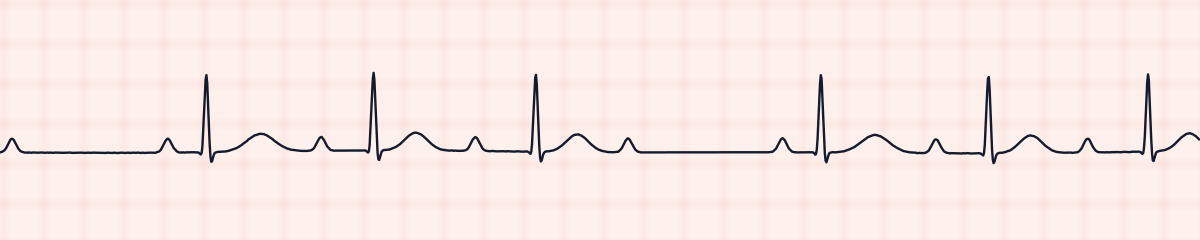
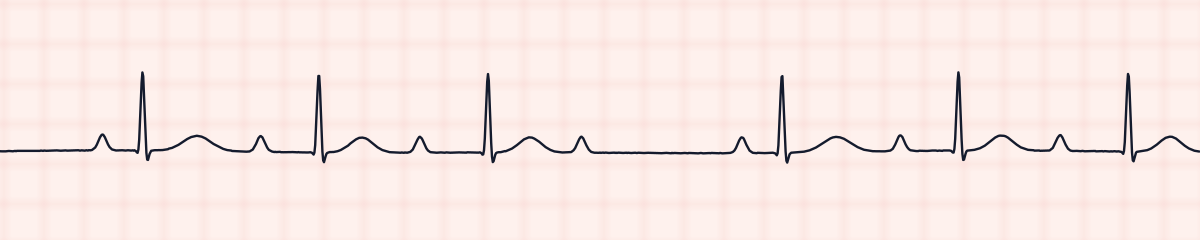
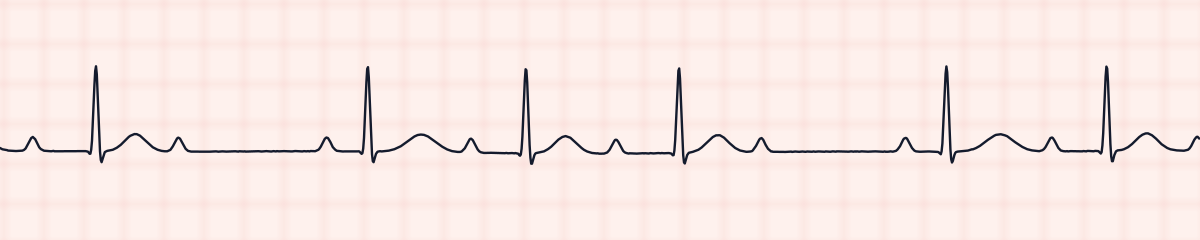
More Wenckebach strips: no two are the same
A rhythm is a set of rules, not a picture. These three strips all meet the rules for Wenckebach, with different numbers.
What Wenckebach gets mistaken for
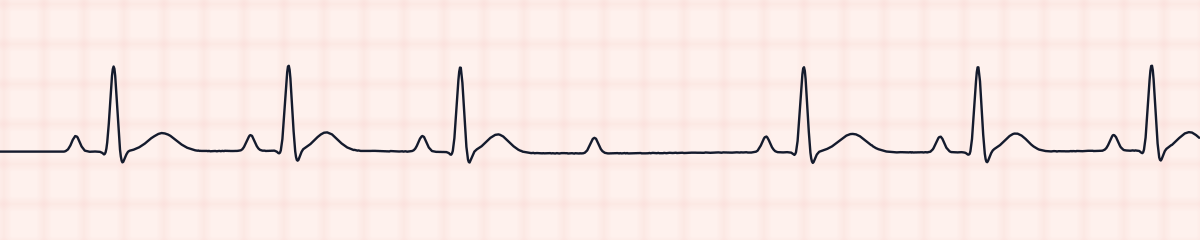
Wenckebach vs. second-degree AV block, type II (Mobitz II)
Both drop beats. Compare the PR interval just before the dropped beat with the PR just after it. In Wenckebach the one before is clearly longer. In Mobitz II they are the same.
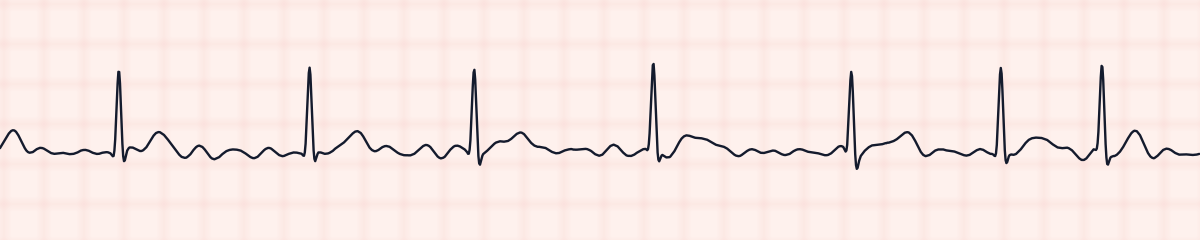
Wenckebach vs. atrial fibrillation
Both are irregular, and at a glance grouped beats can look like atrial fibrillation. Wenckebach has clear P waves and its irregularity repeats in a pattern. Atrial fibrillation has no P waves and no pattern.
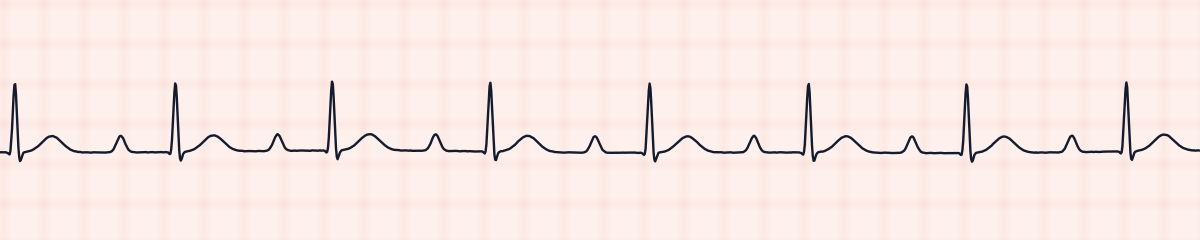
Wenckebach vs. first-degree AV block
A long PR on the last beats of a Wenckebach cycle can look like first-degree block. First-degree block never drops a QRS and its PR never changes.
Practice: Wenckebach or a look-alike?
Five strips. Some show Wenckebach; the others are the rhythms most often confused with it.
Strip 1 of 5
Lead II · 25 mm/s · 6 s
Causes of Wenckebach
- High vagal tone: sleep, athletes, vomiting
- AV-nodal blocking medication, most often a beta blocker, a calcium channel blocker or digoxin
- Inferior myocardial infarction
- Myocarditis
- After cardiac surgery
Why it matters
Wenckebach is the more forgiving of the two second-degree blocks. It is often temporary, it rarely progresses to complete heart block, and many patients have no symptoms. Its importance for a learner is that it must not be confused with Mobitz II, which looks similar and is handled very differently.
What is done for Wenckebach
- Assess for symptoms of a slow heart rate: dizziness, low blood pressure, fatigue.
- If the patient is stable, monitor and look for a reversible cause, especially medication.
- If the slow rate is causing symptoms, atropine is the usual first drug.
- A permanent pacemaker is seldom needed.
Study summary, not a protocol. Follow current American Heart Association guidelines and your facility’s policies. See the medical disclaimer.
Common mistakes with Wenckebach
- Looking at only two PR intervals. The lengthening is easiest to see by comparing the first PR after a pause with the last PR before the next pause.
- Calling 2:1 block Wenckebach. When every second P wave is blocked there are never two conducted beats in a row, so lengthening cannot be shown and the type cannot be named from the strip.
- Missing the dropped P wave because it is hiding in the T wave of the beat before.
Questions about Wenckebach
How do you recognize Wenckebach on an EKG strip?
Follow the PR interval across a group of beats. It gets progressively longer, then a P wave appears with no QRS after it, and the next PR is short again. The saying is “longer, longer, longer, drop.”
Is Wenckebach the same as Mobitz I?
Yes. Second-degree AV block type I, Mobitz type I and Wenckebach are three names for the same rhythm.
Why does the R-R interval get shorter in Wenckebach?
The PR interval grows with each beat, but by a smaller amount each time. Because the added delay shrinks, each QRS arrives a little sooner after the last one than the one before did, so the R-R intervals shorten until the dropped beat.
Is second-degree type 1 heart block serious?
It is usually the less serious second-degree block. It is often temporary and rarely needs a pacemaker. It is treated when the slow heart rate causes symptoms.