Ventricular rhythms
Sinus Bradycardia With a PVC Couplet on an EKG Strip
Sinus bradycardia with a PVC couplet is a slow sinus rhythm that contains one pair of premature ventricular contractions. The sinus beats come fewer than 60 times a minute, each with an upright P wave and a narrow QRS. Somewhere along the strip two wide beats appear one right after the other, ahead of the next sinus beat, with no P wave before either of them and no normal beat in between.
Criteria from the American Heart Association guidelines and published ECG standards · Every strip checked by measurement · Sources and method · Updated November 15, 2026
- Rate
- Sinus beats < 60
- PR interval
- 0.12–0.20 s on the sinus beats
- QRS
- Narrow, with two wide beats in a row
How to identify sinus bradycardia with a PVC couplet in five steps
Ask the same five questions of every strip. The right-hand column is what each one finds on the strip above.
1Rate
Take it from two sinus beats that are next to each other: more than 25 small squares (five large ones) between their R waves means slower than 60. Counting every QRS in six seconds adds the pair in and can hide the slow rate.
Sinus beats 45 bpm
2Rhythm
Slow and regular, interrupted once by two early beats and the long gap behind them.
Regular, with two early beats in a row
3P waves
One upright P wave ahead of each sinus QRS. Neither beat of the pair has one.
None on the early beats
4PR interval
0.12 to 0.20 seconds on the sinus beats, unchanged before and after the pair.
0.18 s on sinus beats
5QRS
The sinus complexes are narrow. The two early ones measure 0.12 seconds or more apiece and resemble each other.
0.09 s; early beats 0.17 s
What is happening in the heart
The sinus node is firing slowly, which leaves a long quiet stretch after every beat. That stretch gives an irritable spot in a ventricle time to fire before the next sinus impulse is due, and here it fires twice in quick succession. Both impulses spread slowly through the muscle, so both complexes are wide. The sinus node keeps its own slow time throughout; the P wave it produces during the pair is buried in the wide complexes, and the ventricles are in no state to answer it. The next sinus beat that can get through arrives after a long gap.
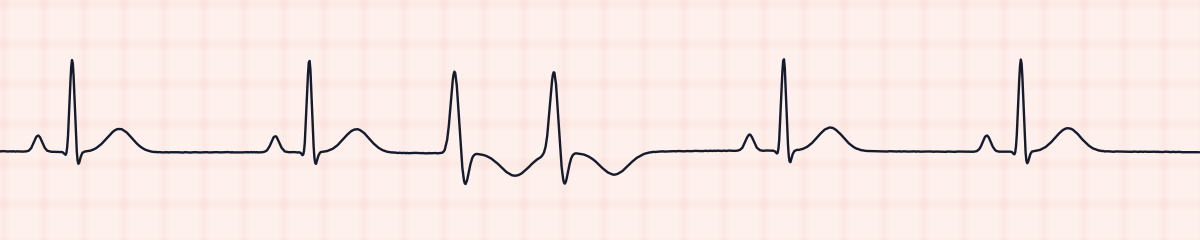
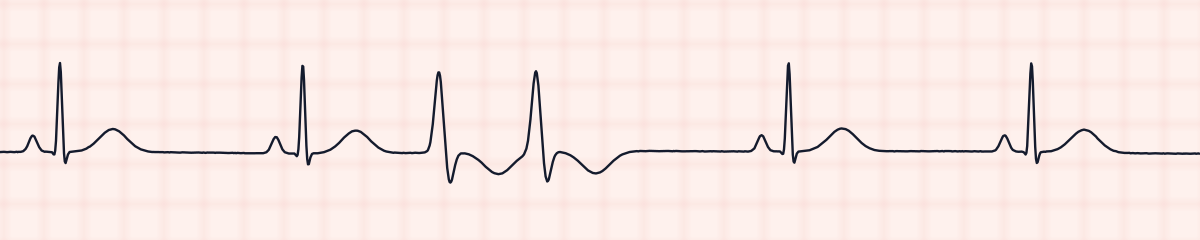
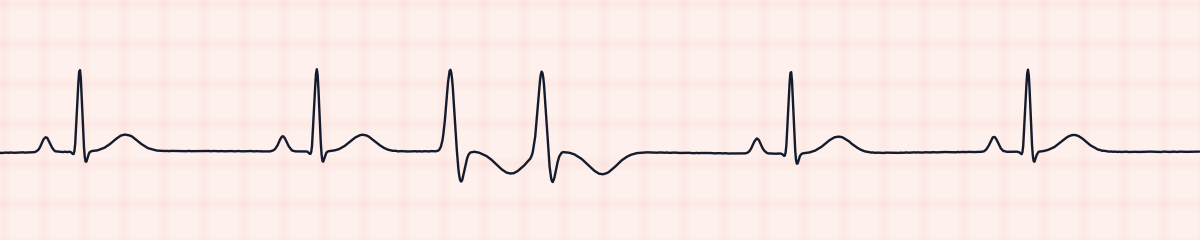
More sinus bradycardia with a PVC couplet strips: no two are the same
A rhythm is a set of rules, not a picture. These three strips all meet the rules for sinus bradycardia with a PVC couplet, with different numbers.
What sinus bradycardia with a PVC couplet gets mistaken for
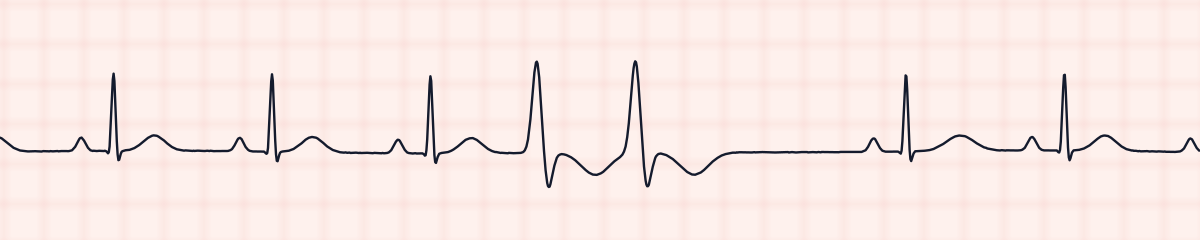
Sinus bradycardia with a PVC couplet vs. ventricular couplet (paired PVCs)
A PVC couplet in a sinus rhythm of 60 to 100 has the same two wide beats. What differs is the distance between the sinus beats: five large squares or fewer there, more than five here.
Sinus bradycardia with a PVC couplet vs. sinus bradycardia
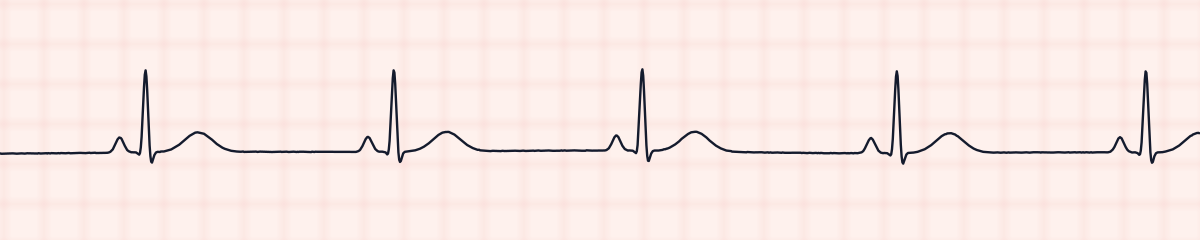
Sinus bradycardia alone is slow and perfectly even, and every QRS on the strip is narrow.
Sinus bradycardia with a PVC couplet vs. ventricular triplet (three PVCs in a row)
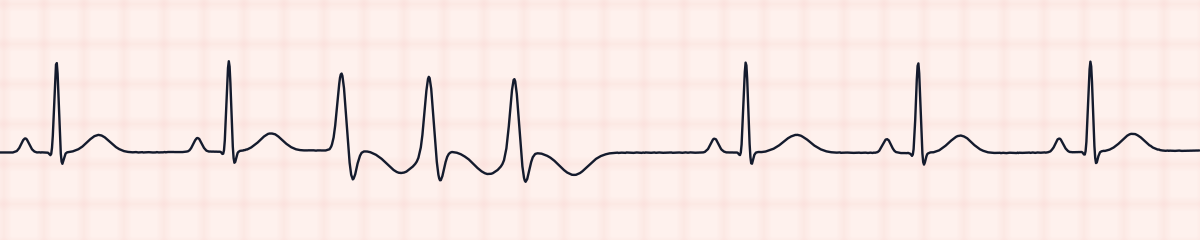
Count the wide beats that touch. Two is a couplet. Three of them, coming faster than 100 a minute, already meet the definition of a run of ventricular tachycardia.
Sinus bradycardia with a PVC couplet vs. third-degree (complete) AV block
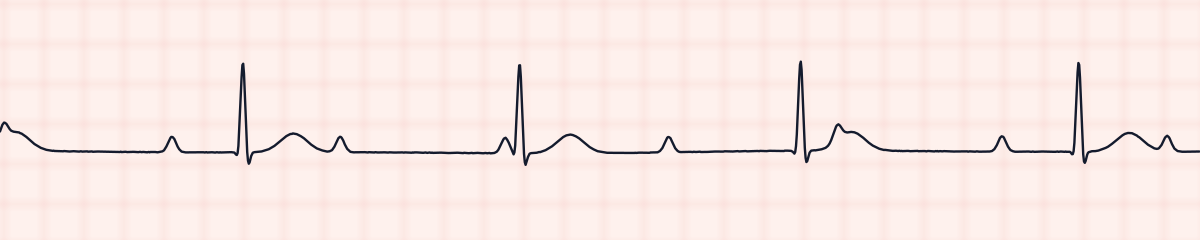
Complete heart block can show a slow rate and wide complexes together. Its wide beats are the regular escape rhythm, though, not an early pair, and its P waves outnumber the QRS complexes and have no fixed distance to them.
Sinus bradycardia with a PVC couplet vs. ventricular bigeminy
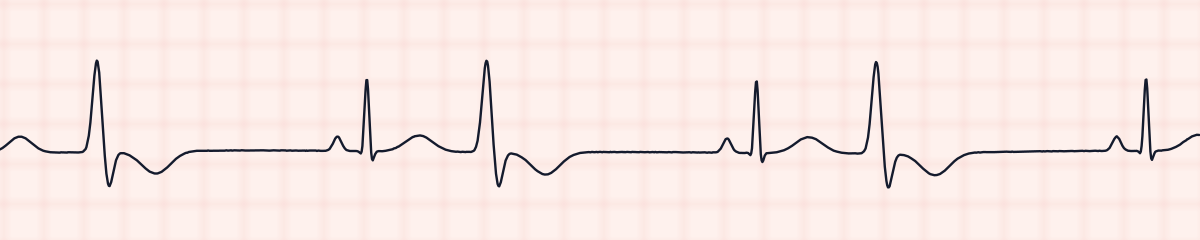
Bigeminy also groups beats in twos, but each group is one narrow sinus beat and one wide beat. In a couplet both beats of the pair are wide.
Practice: sinus bradycardia with a PVC couplet or a look-alike?
Five strips. Some show sinus bradycardia with a PVC couplet; the others are the rhythms most often confused with it.
Strip 1 of 5
Lead II · 25 mm/s · 6 s
Causes of sinus bradycardia with a PVC couplet
- Digoxin, which slows the sinus node and in excess provokes ventricular ectopy: this pairing is a classic picture of toxicity
- Beta blockers, diltiazem, verapamil or amiodarone slowing the rate in a patient who has PVCs for another reason
- An inferior heart attack
- Low potassium or low magnesium
- Low oxygen, including during sleep apnea
- An underactive thyroid or a low body temperature
- Scarred or weakened heart muscle from an earlier heart attack or cardiomyopathy
Why it matters
A couplet ranks above single PVCs in how closely it is watched. Two ventricular beats in succession show that the irritable focus can fire repeatedly, and the next step up is a run of three or more, which is ventricular tachycardia. The slow rate matters in its own right if it lowers blood pressure or causes dizziness, and it matters here for a second reason: long pauses make it easier for ventricular beats to break through. A slow rate with ventricular ectopy in a patient who takes digoxin should always raise the question of toxicity.
What is done for sinus bradycardia with a PVC couplet
- Check the patient: pulse, blood pressure, level of alertness, any dizziness or chest discomfort.
- Document the sinus rate measured between sinus beats, and that the PVCs came as a pair.
- Review the medication list for rate-slowing drugs, and find out when digoxin was last given and whether a level is due.
- Potassium and magnesium levels are usually drawn.
- Report a new couplet, more than one couplet, or any run of three or more wide beats without delay.
- Bradycardia that produces symptoms is managed along the unit’s bradycardia pathway under the provider’s direction.
Study summary, not a protocol. Follow current American Heart Association guidelines and your facility’s policies. See the medical disclaimer.
Common mistakes with sinus bradycardia with a PVC couplet
- Getting the rate from a six-second count. Four sinus beats plus the pair is six complexes, “60 a minute”, and the bradycardia disappears from the report.
- Calling the pair an escape rhythm. Escape beats come late, after a pause; these come early, before the next sinus beat was due.
- Calling two wide beats ventricular tachycardia. A run needs at least three.
- Reporting “PVCs” without saying that they were consecutive.
- Mistaking the long gap after the pair for a sinus pause or a blocked beat.
Questions about sinus bradycardia with a PVC couplet
What is a PVC couplet?
Two premature ventricular contractions in a row, with no normal beat separating them. They are usually the same shape, come close together, and are followed by a pause before the underlying rhythm resumes.
How do you find the heart rate on a strip with a couplet?
Name the underlying rhythm from the sinus beats alone. Pick two neighbouring sinus beats, measure from one R wave to the next in small squares, and divide 1500 by the result. If the answer is under 60, the underlying rhythm is sinus bradycardia.
Is a PVC couplet in sinus bradycardia serious?
It is taken more seriously than isolated PVCs, because consecutive ventricular beats can lead on to ventricular tachycardia. How urgent it is depends on the patient: symptoms, electrolyte levels, medication and whether the couplets keep coming.
How is a couplet different from a run of V-tach?
The number of wide beats in a row. Two is a couplet; three or more at a rate faster than 100 a minute is ventricular tachycardia, however briefly it lasts.